

Agave attenuata is commonly known as the Spineless Century Plant, thanks to its smooth, soft-edged leaves that lack the sharp teeth and terminal spines found in many other agaves. While the name “Century Plant” is more often associated with Agave americana, this species is also notably long-lived.
It is also widely referred to as Foxtail Agave, Swan’s Neck Agave, and Lion’s Tail, all names inspired by the distinctive shape of its flowering stalk.
Features and Growth Habit
Although Agave attenuata typically grows to around 1 metre in height and is primarily valued for its soft grey-green foliage, it produces a spectacular flower spike that can exceed 2 metres.
The flowering spike emerges as a single arching stem. Due to its size and weight, it bends gracefully to form a curved shape. Flowers open progressively from the base upwards, creating a striking resemblance to a large foxtail—hence one of its most popular common names.
Is Agave attenuata one of the best agaves for home gardens?
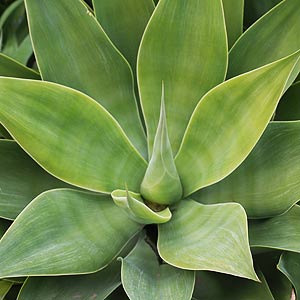
If you’re looking for an agave that’s attractive, easy to grow and relatively safe around people, Agave attenuata is hard to beat. Its smooth, almost spineless leaves and naturally symmetrical shape give you the architectural appeal of an agave without the sharp teeth and spines found on many other species.
It holds its structure beautifully as it matures, making it an excellent feature plant for courtyards, patios, pool areas and garden beds. It’s also relatively drought tolerant, grows well in containers and produces offsets that can be used to grow new plants.
We grow ours in a glazed ceramic pot, a succulent potting mix, fertilise once a year and we repot it every 3 – 5 years.
For most home gardeners in warm, frost-free climates, Agave attenuata would be one of our top choices — especially where safety and low maintenance are important.
Flowering and Lifecycle
The flowering event is often referred to as a “Death Bloom”, as the main plant dies after flowering. However, this usually occurs only after many years—typically around 20–30—and by that time, the plant will have produced offsets (or “pups”) to continue its lifecycle.
Like all agaves, Agave attenuata is monocarpic, meaning it flowers once and then dies. Fortunately, the offsets quickly replace the parent plant.
Landscape Uses
Widely used in landscaping, Agave attenuata is prized for its strong architectural form and soft foliage.
It works well as:
- A feature plant in garden beds
- A container specimen
- A mass planting for structural impact
While the foliage is a major drawcard, some gardeners consider the flower spike undesirable due to the plant’s eventual death.
Additional landscape uses include:
- Creating a tropical look near pools
- Adding structure in rock gardens
- Growing beneath trees or taller shrubs for light shade
- Using the cleaned trunk as a sculptural feature
In containers, plants can be moved easily and even brought indoors for short periods.
How to Grow Agave attenuata (Basic Care)
Agave attenuata is easy to grow, especially in hot, dry climates.
- Position: Full sun to light afternoon shade
- Soil: Well-drained soil (succulent mix recommended)
- Watering: Drought tolerant once established
- Fertiliser: Apply slow-release fertiliser once or twice a year
- Frost: Protect from frost; tolerates only mild conditions
For best foliage appearance, protect plants from harsh afternoon sun to prevent leaf burn.
It also performs well in containers, provided drainage is excellent.
Propagation
Propagation is simple and can be done by:
- Seed, or
- Offsets (pups)
Removing offsets not only provides new plants but also helps maintain the clean architectural form. Alternatively, they can be left to form a larger clump and transplanted later.
Repot pups into a specialist cactus and succulent potting mix. Keep newly planted pups in light shade and under cover to reduce stress from direct sun and allow better moisture control.
Hold back on watering for two weeks. Water once, then allow the soil to dry before watering again.
Pruning and Maintenance
Pruning Old Foliage
As older leaves die, they tend to collect on the trunk. Many gardeners remove this foliage to improve appearance. Cleaning the trunk can also help reduce the risk of pests.
Remove old foliage once it has browned and dried. Often it can be pulled away easily; if not, use a sharp knife or secateurs.
Clear away any debris from around the base of the plant and where leaves meet the stem. This improves appearance and helps reduce the chance of rot.
Managing Offsets (Pups)
There are two types of offsets:
- Basal offsets (growing from the base)
- Aerial offsets (forming along the stem)
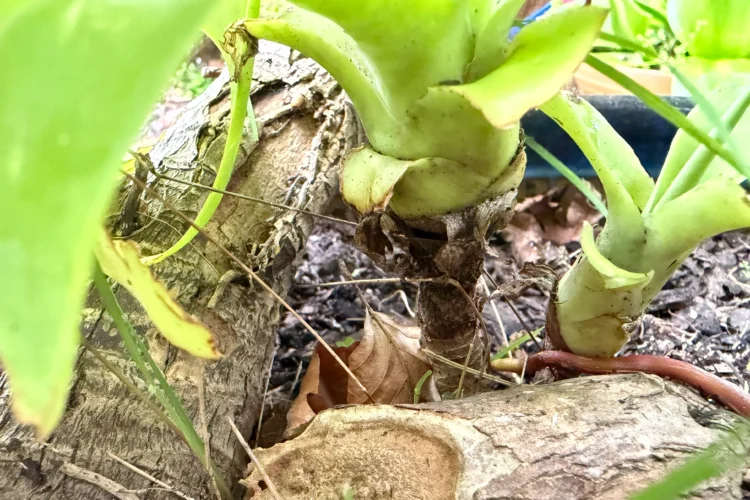
Basal offsets should be left until they reach a good size—around 15 cm—to allow a strong root system to develop.
Aerial offsets can be removed once they reach around 8 cm. Use a sharp knife to detach them from the main stem. Allow them to callus over by placing them in a dry, shaded position for 3–5 days before replanting.
Companion Plants
Suitable companion plants include:
- Other succulents such as Aloes and Echeverias
- Low-growing plants like Blue Chalksticks
- Ornamental grasses such as Blue Fescue
Plant Information
- Botanical Name: Agave attenuata
- Common Names: Lion’s Neck Agave, Swan Neck, Spineless Century Plant
- Height: 1.5–2 metres (including flower spike)
- Spread: Around 1.5 metres
- Growth Rate: Medium
- Flowers: Creamy white on a long spike
- Flowering Time: At maturity (10–20+ years)
- Frost Tolerance: Mild frosts only
- Drought Tolerance: Drought tolerant once established
Where To Buy

Online and Retail Melbourne and Geelong based garden centres. Check out their large range of indoor and outdoor plants, Australian Natives, Fruit Trees and Edibles, Succulents, Gardenias, Camellias, Hydrangeas plus a full range garden products for delivery in Melbourne.
www.diacos.com.au
Wholesale Suppliers Include

111 Stanhope Road Theresa Park NSW 2570
Offering a variety of sun hardy Australian natives and exotic trees, shrubs, groundcover's and perennials from semi advanced through to super advanced and semi-mature stock.
www.downesnursery.com.au

email [email protected]
One of Australia's largest wholesale trade nurseries. Over 30,000 species available, tubestock to advanced trees, an almost unlimited choice of plants.
www.plantmark.com.au


Q & A
What causes black spots on Agave attenuata leaves?
Black spots can be associated with fungal or bacterial problems, prolonged moisture, poor air circulation, physical damage or environmental stress. Check the plant’s growing conditions first. Improve drainage, avoid keeping the foliage or rosette constantly wet and remove badly damaged leaves with clean tools.
Why are the leaves turning brown?
Brown leaves can have several causes, including sunburn, frost damage, drought stress and natural ageing. If the lower part of the plant is soft or the rosette is collapsing, check for overwatering and poor drainage.
Is Agave attenuata really spineless?
Yes. Agave attenuata has smooth leaf margins and does not have the sharp terminal spine found on many other agave species. This makes it a more practical choice for areas beside paths, patios, pools and entertaining spaces.
How do I revive an overwatered Agave attenuata?
First, stop watering and check the drainage. If the soil is staying wet, move the plant into a free-draining mix once conditions allow and remove any soft or rotting tissue with clean tools.
If the crown or base has become soft and collapsed, the damage may be severe. Healthy offsets can sometimes be separated and propagated as replacement plants.