
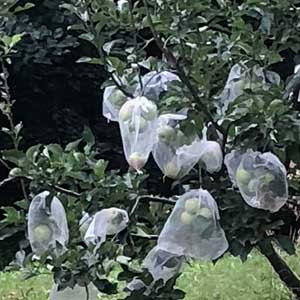
Bird netting is one of the simplest and most effective ways to protect fruit trees, berry crops and vegetable gardens from birds. Whether you’re growing apples, citrus, grapes, strawberries or backyard vegetables, the right netting can prevent significant crop losses while allowing fruit to ripen naturally.
Birds are an important part of the garden, but when fruit begins to ripen they can quickly strip trees and vines of their crop. Choosing the correct type of bird netting, using the right mesh size and installing it at the right time will help protect your harvest while reducing the risk of injury to birds and other wildlife.
From lightweight throw-over netting for home gardens to heavy-duty structural netting used in commercial orchards and vineyards, there are bird netting options to suit almost every situation. Fruit protection bags and bird scarers can also be useful, particularly where only a few trees or individual fruit clusters need protection.
This guide looks at the different types of bird netting, how to choose the right mesh size, when to install it and the accessories that make installation easier, along with other effective and humane ways to protect fruit from birds.
Bird Netting Weights and Sizes
Coming in different meshes and weights for different applications, this type of netting is used in viticulture, fruit production and other food crop industries.
Netting comes in large rolls for commercial application or as cut to length pieces for individual fruit trees and smaller orchards.
Larger rolls are used in commercial applications where large areas such as apple orchards are totally covered.
Large rolls can also use to cover animal enclosures and some home vegetable gardens.
Bird Netting Types
- Structural Bird Netting
This is a heavier type designed for more permanent covering of larger structures. Available in widths up to 15m to suit structural use. - Vine Netting (throw over)
A lighter weight type of netting suitable for throw over application for vine and berry fruit. Available in long lengths to suit use in vine yards - Lightweight
Useful for home gardeners, lighter weight for easy use. - Throw Over Netting
The simple ‘throw over the tree’ method is available in a number of colours including black, with white seeming to be the most popular. Larger trees may be covered more easily by using 2 – 3 pieces and clipping together.
Bag Type Bird Netting
- Mesh bags for the protection of fruit are an alternative to netting a whole tree. You can either make up your own from bird netting or you can buy the bags in packs from hardware stores or online.
- Draw string type bags come in a range of sizes to fit different fruit trees and are easy to use. These bags are usually reusable and can also be used to protect the forming fruit on pomegranates and native citrus tree.
- Fruit protection bags differ a little in that they are designed to protect fruit from fruit fly and other insects as well as from sunburn. They also act as a a deterrent to and provide some protection from birds.
It is best to look for UV stabilised netting longer lasting properties. For netting used larger structural applications heavier GSM is available in rolls to 15m wide.
Accessories include
- Post caps to prevent material being worn or cut on rough surfaces.
- Clips to allow nets to be secured around irregular shapes.
- Repair or lacing cord to join netting or repair damaged nets.
Other fruit protection methods – Bird Scarers
Bird scarers work differently and come in a range of types, all with merits depending on application.
Infra red Bird scares work in a number of ways, one particular type works by detecting birds through the use of infra red detection sensors and thus activating a short high pressure burst of water from a sprinkler, this system works on batteries.
Bird Tape or Humming Line
Humming line is strung through orchards, it vibrates in the wind and produces a sound that will help deter or scare birds.
Visual Bird Scarers
Hawks, Cats, Eagles and other predators are replicated in model or cut out form and act a visual deterrent or scarer
Infra Red Bird Scarers
Activated by motion, infra red bird scarers either emit sound, or a burst of water that is designed to scare birds away.
Bird Scarers, Bird Repellent and Bird Netting are all widely used in the garden and include devices such Hawk Bird Scares, Humming Lines, Infra red bird scarers, Bird Netting, Gas Guns and Electronic Bird Scarers.
Humane Bird Deterrents all work by providing an unpleasant experience for the bird and deterring or scaring it from coming back to fruiting trees, newly planted lawns etc.
Contact your local RSPCA for advice on protecting plants from both domestic and native birds. The aim is to have a peaceful co existence between food crops, horticultural production and birds.
Choose the right size Netting
Netting Size is designed to exclude different things. Birds and butterflies are prime examples. Butterfly netting is usual a finer mesh, bird netting larger..
Net Size is important when applying to fruiting crops. It is usually bird netting we are applying to fruit crops such as strawberry, raspberries and many fruiting trees. This means a mess size of 5mm and larger.
Small or fine mesh, such as 4 mm can also stop polinators, such as bees, so your harvest can be decreased. It does not have a major effect on wind pollination.
When to apply netting
You can apply netting after flowering, however some crops are still producing flowers after the first fruit has formed, So again, choosing the right netting is the real answer.
Wildlife Safe Bird Netting
Bird netting is an effective way to protect fruit and vegetables, however it should always be used responsibly to avoid harming birds, bats, reptiles and other wildlife.
The safest option is to use wildlife-safe netting with a small mesh size of around 5mm. Fine mesh netting is less likely to trap birds or other animals than larger mesh sizes. Whatever type of netting you choose, it should be installed so that it is stretched tightly over a frame or support rather than loosely draped over plants or trees.
Loose netting can create pockets where birds, flying foxes, lizards and even snakes may become entangled. Regularly inspect netting during the fruiting season to ensure it remains secure and to check that no wildlife has become trapped.
Install bird netting after flowering has finished so that bees and other pollinating insects can access flowers. Once the crop has been harvested, remove the netting and store it out of direct sunlight to extend its life and prevent it becoming a hazard to wildlife.
For individual fruit trees or small crops, reusable fruit protection bags can be a practical alternative. These protect developing fruit from birds, fruit fly and some insect pests without the need to cover the entire tree.
By choosing the correct netting and installing it properly, you can protect your harvest while helping to ensure birds and other native wildlife remain safe.
Wildlife Safety Tips
- Use wildlife-safe netting with a mesh size of around 5mm.
- Stretch netting tightly over a frame or support to avoid loose pockets.
- Install netting after flowering has finished to allow pollination.
- Check netting regularly for damage or trapped wildlife.
- Remove netting as soon as harvesting is complete.
- Repair or replace damaged netting before using it again.
Australian wildlife organisations often recommend 5 x 5 mm knitted netting specifically, as it greatly reduces the risk of entanglement compared with larger diamond-shaped meshes.