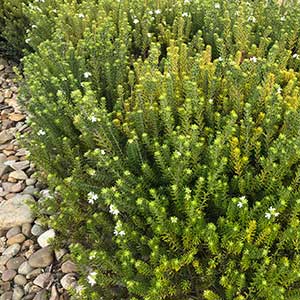

Carpenteria californica, commonly known as Tree Anemone or Bush Anemone, is a rare and highly attractive evergreen shrub prized for its large white flowers and glossy foliage. Easy to grow and low maintenance, it makes an excellent feature plant for gardens seeking structure, elegance, and long seasonal interest.
Quick Growing Tips
- Plant in well-drained soil
- Provide sun to light shade
- Mulch to conserve moisture
- Prune after flowering
- Avoid overwatering
What is Carpenteria californica?
A native of California, particularly the Sierra Nevada foothills, Carpenteria californica is a dense, upright evergreen shrub that typically grows to around 2–3 metres tall and about 1.5 metres wide.
Closely related to Philadelphus (Mock Orange), it shares similar floral characteristics, including lightly fragrant blooms and bright yellow stamens. In the wild, it is considered rare, but it is widely appreciated in cultivation for its reliability and ornamental appeal.
With attractive peeling bark and lush, elongated dark green leaves, this is a plant that provides year-round interest, even when not in flower.
Flowers and Foliage
The standout feature of Carpenteria californica is its large, white flowers, which resemble anemones—hence the common name.
- Flowers are 5–6 cm across
- Crisp white petals with prominent yellow centres
- Lightly fragrant
- Appear in clusters over late spring to early summer
- Flowering period lasts around 6–8 weeks
The glossy evergreen foliage provides a clean backdrop that enhances the brightness of the blooms, especially in lightly shaded positions.
How to Grow Carpenteria californica
A native of California, Carpenteria californica is reasonably drought tolerant it requires good drainage, keep well mulched for best results.
This is a relatively easy-care shrub when planted in the right conditions.
- Position: Full sun to light shade; prefers afternoon shade in warmer climates
- Soil: Well-drained soil is essential; avoid heavy or waterlogged sites
- Water: Drought tolerant once established, but benefits from occasional deep watering
- Mulch: Apply organic mulch to retain moisture and regulate soil temperature
Although adaptable, good drainage is critical to long-term success.
Sun or Shade?
Carpenteria californica grows well in both full sun and partial shade.
- In cooler climates: Full sun encourages better flowering
- In warmer regions: Afternoon shade helps prevent stress and leaf scorch
This flexibility makes it suitable for a wide range of garden positions.
Size and Spacing
Understanding mature size helps with proper placement.
- Height: Typically 2–3 metres (can reach up to 4–8 feet / 1.2–2.5 m in some conditions)
- Width: Around 1.5 metres
- Spacing: Allow at least 1.5–2 metres between plants for airflow and shape
Ideal as a feature shrub, informal hedge, or part of a mixed planting.
Pruning and Maintenance
Carpenteria californica responds well to pruning and can be shaped to suit most garden styles.
- Lightly prune or pinch back after flowering to maintain shape
- Prune up to one-third after flowering to encourage bushier growth
- Older plants can be rejuvenated with harder pruning if needed
Minimal pruning is required if a more natural form is preferred.
Propagation
Propagation is possible but can be slow.
- Semi-hardwood cuttings taken in late summer
- Use a well-draining propagation mix
- Keep in a warm, sheltered position
Propagation from cuttings is the most reliable method for maintaining plant characteristics.
Common Problems
Generally a hardy and trouble-free plant, Carpenteria californica has few major issues.
- Poor drainage can lead to root problems
- Overwatering may reduce vigour
- Occasional leaf scorch in extreme heat without shade
Good site selection prevents most problems.
Why Grow Carpenteria californica?
A combination of beauty, structure, and resilience makes this plant a standout.
- Evergreen structure for year-round appeal
- Showy, lightly fragrant flowers
- Drought tolerance once established
- Suitable for both formal and informal gardens
- Rare in the wild, adding uniqueness to plantings