
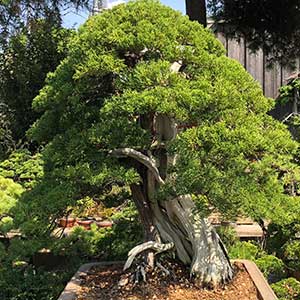
What is Bonsai?
Bonsai is the art of growing and training trees in containers to create miniature versions of mature trees found in nature. Combining horticultural skill with artistic design, bonsai allows gardeners to create living sculptures that can be enjoyed for decades and, in some cases, centuries.
To be true to the art, bonsai trees are usually grown in containers from an early age. They are trained, pruned and root pruned over many years to develop character, balance and the appearance of age. In Japan, some bonsai specimens are hundreds of years old, with a few famous examples believed to be approaching 1,000 years in age.
The choice of pots, growing media and specialised tools is an important part of bonsai culture, and these are readily available through specialist nurseries and bonsai suppliers.
Although bonsai is closely associated with Japan, the practice originated in China before evolving into the art form we recognise today.
A common question is whether any tree growing in a pot can be called a bonsai. Traditionally, the answer is no. The Japanese concept of mochikomi refers to the process of a tree maturing in a container over many years, developing the character and aged appearance that distinguish a true bonsai from an ordinary potted plant
Bonsai Trees, Tools and Pots
Popular in many countries, the art of Bonsai revolves around growing trees in containers. To be true to the art, the trees should be container grown from a very early age. They are grown in shallow bowls and trained, pruned and root pruned into a number of recognised styles.
It is possible to take lessons in the art of bonsai and grow your own trees, or you can purchase advanced trees. In Japan you will find examples of trees that are 100s of years old, some said to be nearly 1000 years old.
The choice of pots, and the tools in basic care used are important and can also be purchased from specialist nurseries.
Bonsai Tree Styles
Over time, a number of recognised bonsai styles have developed. These styles are inspired by the way trees grow in nature and help guide the training and shaping process.
The five major bonsai styles include:
- Moyogi – An informal upright style with gentle curves in the trunk.
- Shakan – A slanting style that resembles a tree shaped by wind and weather.
- Kengai – A cascading style where the trunk grows downward over the edge of the pot, often resembling trees growing on cliffsides.
- Hokidachi – A broom or fan-shaped style, often symmetrical and elegant.
- Bunjin-gi – A minimalist style representing the idealised form of a mature tree.
Best Trees for Bonsai
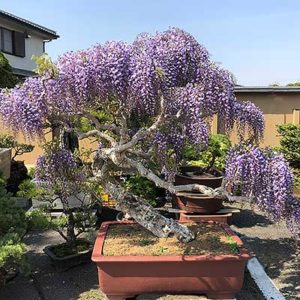
Technically, almost any tree or shrub that tolerates root pruning, regular trimming and restricted root space can be trained as a bonsai.
Popular bonsai species include:
- Ficus
- Juniper
- Japanese Black Pine
- Chinese Elm
- Japanese Maple
- Wisteria
- Jade Plant
Australian gardeners also have a number of excellent native options. Dwarf forms of Baeckea virgata are particularly well suited to bonsai culture, developing attractive branching and fine foliage.
Getting Started with Bonsai
For beginners, success with bonsai starts with choosing a suitable species and learning a few basic techniques.
- Start with a healthy young plant or bonsai starter.
- Use a specialist bonsai potting mix.
- Learn basic pruning and shaping techniques.
- Repot when required.
- Provide the correct light and watering conditions for the species.
Patience is an important part of bonsai. The most attractive specimens are developed gradually over many years.
Repotting Bonsai Trees
Repotting is an essential part of bonsai care and serves two main purposes.
The first is to refresh the growing medium. In this case, the tree is removed from the pot, the old growing medium is replaced and the cleaned container is reused.
The second is to provide a larger container when the tree begins to look out of proportion to the pot or becomes top heavy.
Always use a quality bonsai potting mix designed to provide excellent drainage while retaining sufficient moisture for healthy root growth.
Growing Bonsai Indoors or Outdoors
Many people think of bonsai as indoor plants, however most bonsai species are naturally outdoor trees.
While some species, particularly tropical varieties such as ficus, can be grown indoors, they still require good light, ventilation and careful watering. Most bonsai benefit from spending at least part of the year outdoors where they receive fresh air and natural light.
Local bonsai clubs are often the best source of information on which species perform best in your climate.
Essential Bonsai Tools and Pots
Specialised tools make pruning, wiring and repotting easier and help achieve more precise results.
Basic bonsai tools include:
- Pronged rake with shovel – Used for working around roots and firming soil into place.
- Miniature broom – For cleaning the surface of the bonsai and work area.
- Leaf tweezers – Useful for removing dead leaves and debris.
- Wire cutter scissors – Designed for removing training wire safely.
- Pruning shears – Used for general pruning and trimming.
- Bonsai jin pliers – Used when applying or removing wire from branches and trunks.
- Butterfly shears – Ideal for trimming leaves, roots and fine branches.
Choosing the right bonsai pot is also important. The pot should complement the tree and remain in proportion to its overall size and style.
Bonsai Starter Trees
Bonsai starters are young trees grown specifically for bonsai training. They are root pruned from an early age to encourage the development of a dense, fibrous root system that is suitable for shallow containers.
Good-quality starters are usually between four and six years old. By this stage, tap roots have been reduced and a strong network of fine roots has developed, making future training and repotting much easier.
Ever wondered why Bonsai trees are not planted in a normal potting mix, but a coarser type ? Three reasons, one to provide good drainage and secondly to allow the mix to stay open and have plenty of oxygen in it, stopping the soil from going sour. And thirdly, the coarser mix encourages root development.
So to successfully grow healthy Bonsai trees you require a few special qualities in a potting mix. Specialist Bonsai soils are available, we outline the qualities to look for in a Potting Mix for Bonsai.
Pre preprepared soils can be purchased from specialist nurseries. Bonsai Clubs and societies are a great source of information on Bonsai Soil Requirements.
Simple Bonsai Potting Mix Recipe
This is perhaps an over simplification as the inert material may in fact be a combination of 2 or 3 types of crushed rock or similar material. However you will get the point, excellent drainage and good aeration.
- 3 Parts Crushed inert rock, such as granite, quartz, scoria, gravel or products such as Diatomite or Akadama
- 1 Part Coco Peat or very fine pine bark
Bonsai Soil Requirements
- Bonsai are grown in small pots with very shallow soil and require a specialist potting mix to do well.
- They require good drainage and potting mix that is well aerated to promote root growth.
- A simple home made potting mix would be 4 parts normal good quality potting mix and 1 part small stones or very course washed sand.
Bonsai Trees, Pots and tools for sale online.
More Bonsai Nurseries
BONSAI GOLD COAST
Robyn Tarrant Mobile number 0424640110
Bonsai: styling and maintenance, tuition, tree minding, buying and selling, supplier of potting mediums including: Akadama, Pumice, Scoria, Zeolite.
www.bonsaigoldcoast.com
B for BONSAI – phone 0426 210 771
Craigieburn, VIC
Bonsai trees, Japanese Black Pines, handmade bonsai and accent plant pots.
BONSAI ISLAND – phone: 03 5956 6388 fax: 03 5956 6388
32 Phillip Island Road Newhaven Vic 3925
Gallery & Sales Open every Sat & Sun 10am-5pm also by appointment
BALCONY BONSAI – phone: 0415 148678
Cudgen Rd Cudgen NSW 2487
Courses, resources, tools and general information on all things bonsai.
ROCKY PEAK BONSAI phone: 0404098089
Gold Coast Queensland QLD: 4213
Trees, tools, pots, wire, accessories etc
BONSAI AT THE BAY – phone: 0244418005
Streamside St Woollamia NSW 2540
We specialise in styling large specimens. Servicing , starters, pots, tools and moss all available.
LEDANTA BONSAI NURSERY – phone: 0419185818
24 Beltana Road Pialligo ACT 2609
Canberra’s Home Of Award Winning Bonsai. Retail and Wholesale Nursery. Sales, Service, Classes, Hire.
BUYABONSAI.COM.AU phone: 07 5576 1705
2061 Gold Coast Hwy Miami Gold Coast QLD 4220
Trees up to 50% of retail.Purchase ready to go trees, shaped, potted and wired.
BONSAI AUSTRALIAN GROWER – PH/Fax (07) 38033060
190 Hubner Rd Park Ridge QLD 4125
Stock, Pots, B Tools, Workshops & Classes
BONSAI KINGDOM
e-mail: [email protected]
Range of Glazed and Unglazed Pots, Chinese and Japanese Tools, excellent selection of Books.