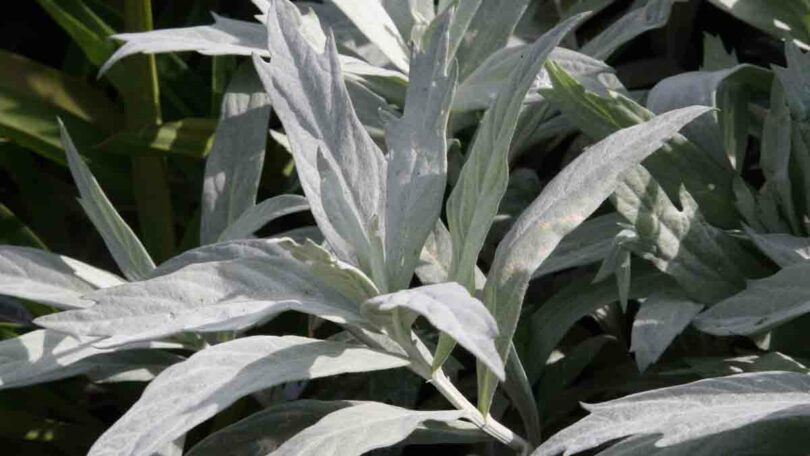
Grown primarily for their silvery-green foliage, Artemisia plants make excellent contrast plants in the garden.
Their soft, finely textured leaves pair beautifully with flowering perennials and deeper green foliage. Easy to care for and fairly drought tolerant, Artemisia are well suited to cottage gardens, mixed borders, and containers.

Commonly known as Wormwood, Artemisia belong to the Asteraceae family and fall into two main groups: herbaceous varieties and shrubs.
One of the more interesting species is Artemisia dracunculus, commonly known as French tarragon
Key Features at a Glance
- Height and spread: Most garden varieties range from 15 cm to around 1 m tall, with a similar or slightly wider spread depending on the species.
- Habit: Forms vary from tight mounds and low clumps to airy, shrubby plants.
- Foliage: Finely divided, often aromatic leaves, usually in shades of grey, silver, or blue-green.
- Flowers: Small and generally insignificant, grown mainly for foliage rather than bloom.
- Climate: Best in temperate climates with dry summers; dislike humid, waterlogged conditions.
- Uses: Borders, rock gardens, edging, ground cover, and foliage contrast in mixed plantings.
Why Grow Artemisia?
Shrub forms of Artemisia are particularly valued for their foliage, especially the silver and grey-leaved varieties. One of the most popular is Artemisia schmidtiana ‘Silver Mound’ Nana, a low-growing, compact plant that works well as ground cover or edging.
Foliage colour ranges from pale grey to bright silver, making Artemisia an excellent accent plant that enhances surrounding colours and textures.
Popular Artemisia Varieties for the Garden
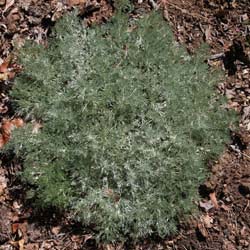
Many Artemisia varieties deserve a place in the garden, including both compact and shrubby forms. Some of the most useful and reliable are:
- Artemisia schmidtiana ‘Silver Mound’ nana – a low, soft mound of silver foliage, ideal for edging and front-of-border planting.
- Artemisia canescens – a slowly spreading, low-growing wormwood suited to dry, sunny positions.
- Artemisia ludoviciana ‘Valerie Finnis’ – grown for its striking silver-grey leaves and vigorous habit.
- Artemisia ‘Powis Castle’ – a popular, finely divided, silver shrub that provides excellent texture in mixed borders.
- Artemisia vulgaris ‘Oriental Limelight’ – valued for its yellow-variegated foliage and ground-covering habit.
- Artemisia stelleriana ‘Mori’s Strain’ – a compact form with soft, silver foliage that works well along paths and in rockeries.
Artemisia canescens
Growing to approximately 15 cm tall, Artemisia canescens is a slowly spreading, non-invasive wormwood that thrives in dry conditions. Its low-growing habit makes it ideal for:
- Rock gardens
- Edging
- The front of well-maintained borders
General Care for Artemisia
Artemisia are low-maintenance plants when grown in the right conditions. Pay attention to light and drainage, and they will reward you with strong growth and good foliage colour.
- Sun: Full sun is essential for compact growth and strong foliage colour. Plants grown in too much shade can become leggy and lose their silver tones.
- Soil: Well-drained soil is critical. Artemisia dislike heavy, waterlogged sites and do best in sandy or gravelly soils.
- Water: Drought tolerant once established, but water regularly during the first growing season to help plants settle in. Avoid overwatering.
- Feeding: Minimal fertiliser is required in good soils. Excess nutrients can lead to soft, floppy growth and reduced resilience.
- Pruning: Cut back in late winter to early spring to maintain shape and encourage fresh growth. Remove any dead or weak stems to keep plants tidy.
- Spacing: Allow enough room between plants for air circulation, especially in humid climates, to help reduce fungal problems.
Simple propagation is usually by division or semi-ripe cuttings taken during the growing season. This allows you to increase your stock of favourite varieties and refresh older clumps over time.
Design and Garden Uses
Artemisia are outstanding foliage plants for adding contrast and cohesion to garden plantings. Their silver and grey leaves highlight richer colours and bring light to darker corners of the border. They pair particularly well with purple, blue, and deep red flowers, as well as ornamental grasses.
Use low-growing forms along paths, in gravel gardens, or at the front of borders where their fine texture can be appreciated up close. Taller, shrubbier types make good background plants or informal hedges in sunny, dry areas. Artemisia also work well in containers, provided the potting mix drains freely and the plants receive plenty of sun.
Artemisia Varieties to Look For
While many species are available, the following are among the most popular and reliable:
- A. vulgaris.
- A. tridentata.
- A. absinthium.
- A. arborescens
- A. ludoviciana – Look for ‘Valerie Finnis”
- A. Silver Spreader
- A.lactiflora ‘Guizhou’.
- A. powis Castle
Final Care Tips
Artemisia (Wormwood) are attractive, drought-tolerant foliage plants that perform beautifully in borders and low-water gardens. Prune back hard in early spring to maintain a neat shape and encourage vigorous new growth.
Where To Buy
PO Box 7040 Leura NSW 2780
Rare woodland plants, Trilliums Epimediums, Arisaemas, plus much more.www.lynnsrareplants.com.au

52 Rodd St Canowindra NSW 2804
An online nursery specialising in drought and frost tolerant perennials and fragrant, edible and herbs.
www.perennialle.com.au

'Umbango' 750 Humula Rd, Humula NSW 2652
Phone 0408692773 Great Range of Perennial plants available for sale by mail order.
www.nutshellnursery.com.au

Little Hampton, Vic 345
"Mail order nursery specialising in cottage garden perennials, flowering shrubs, Trilliums, Hostas and Pacific Coast Iris. Flat rate express postage - Except WA & TAS"
www.botanicaltreasures.com
GENTIANA NURSERY – PH (03) 97512363
OLINDA-MONBULK RD OLINDA VIC.
email [email protected]
More Artemisia Species