

Narcissus Cyclamineus ‘Tete a Tete’ (A Cyclamineus Daffodil Hybrid)
Cyclamineus daffodils are among the most popular miniature daffodils (or miniature narcissus), valued for their elegant flowers, compact habit and reliable early spring display.
They are a distinctive group of small, early-flowering bulbs, originally developed from Narcissus cyclamineus, a species found growing naturally along streams and riverbanks in parts of Spain and Portugal.
Although compact in size, they are among the most elegant daffodils you can grow. Their swept-back petals and slender trumpets give each flower a graceful, windswept appearance unlike any other daffodil. They are excellent for rock gardens, woodland gardens, containers and naturalising beneath deciduous trees.
Today, Cyclamineus hybrids are especially popular in the United Kingdom, the Netherlands, Australia, New Zealand and other cool temperate regions, where they flower reliably in late winter and early spring.
Quick Facts
| Botanical Name | Narcissus cyclamineus |
|---|---|
| Common Names | Cyclamineus Daffodil, Cyclamen-flowered Daffodil |
| Plant Type | Spring flowering bulb |
| Height | 15–25 cm |
| Spread | 10–15 cm |
| Flowering Time | Late winter to early spring |
| Flower Colours | Yellow, cream, white and bicolours |
| Position | Full sun to part shade |
| Soil | Moist, humus-rich, well-drained soil |
| Frost Hardy | Yes |
| Naturalising | Excellent |
| Suitable for Pots | Excellent |
| Wildlife | Deer and rabbit resistant |
What Makes Cyclamineus Daffodils Different?
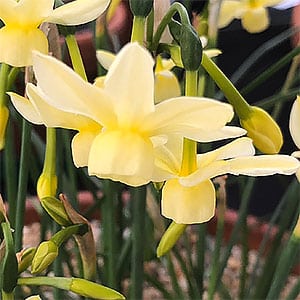
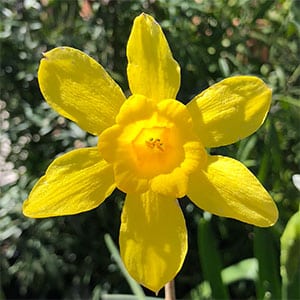
Cyclamineus daffodils are instantly recognisable by their strongly reflexed petals, which sweep sharply backwards, and their long, narrow trumpet. The flowers usually nod slightly on slender stems, creating an elegant appearance that distinguishes them from traditional trumpet daffodils.
They are also among the earliest daffodils to flower and perform particularly well in cooler climates. Their compact size makes them ideal for smaller gardens, rockeries, alpine gardens and container displays where the flowers can be appreciated up close.
Origins and History
The name Narcissus comes from Greek mythology, linked to the story of Narcissus, the youth who became captivated by his own reflection. According to legend, the flower appeared where he died.
The species name cyclamineus refers to its resemblance to Cyclamen flowers, particularly the sharply reflexed petals.
In the wild, Narcissus cyclamineus grows naturally along streams and in damp woodland areas of north-western Spain and northern Portugal. It was introduced into cultivation during the nineteenth century and soon became an important parent species in daffodil breeding. Its unusual flower shape, early flowering habit and compact growth have been passed on to many of today’s popular hybrids.
Flowers and Features of Narcissus cyclamineus

Hybrids and Cultivars
From this single species, a wide range of Cyclamineus hybrids has been developed.
By crossing it with larger daffodil varieties, growers have created intermediate forms—typically 20–25 cm tall—while retaining the characteristic swept-back petals.
Some well-known cultivars include:
- ‘Jetfire’ – bright yellow with a contrasting orange trumpet
- ‘Tête-à-Tête’ – a popular compact variety for mass planting
- ‘Peeping Tom’ – classic yellow tones with strong reflexed petals
- ‘Little Azi’ – a softer white-flowering form
If you’re looking for something a little different for the garden or containers, these are well worth considering.
Growing Cyclamineus Daffodils
Cyclamineus daffodils are easy to grow and suit a range of garden conditions.
Planting Time
Plant bulbs from late summer through to early winter.
Depth
Plant at around 5–8 cm deep.
Soil
Humus-rich, well-drained soil is ideal.
Light
Full sun to light afternoon shade.
Watering
Water during the growing and flowering period (winter through spring). Once dormant in summer, little watering is needed.
Maintenance
Remove spent flowers, but allow foliage to die back naturally to feed the bulb for the following season.
Growth Habit and Garden Uses
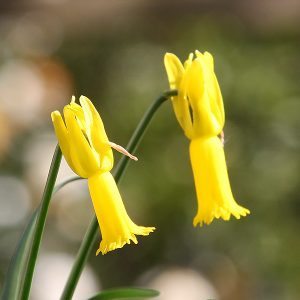
Their compact size makes them especially versatile in the garden.
They are especially suited to:
- Rock gardens
- Woodland gardens
- Cottage gardens
- Alpine gardens
- Containers and window boxes
- Edging pathways
- Naturalising beneath deciduous trees
- Mixed spring bulb displays
Plant them in generous drifts for the greatest visual impact.
Cyclamineus vs Bulbocodium Daffodils
Although both belong to the Narcissus genus and are considered miniature daffodils, they are quite different in appearance.
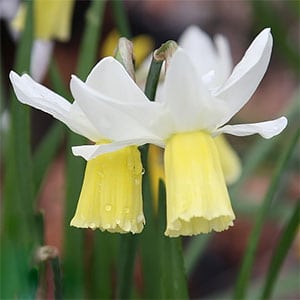
Cyclamineus daffodils have long trumpets with petals swept sharply backwards, creating an elegant, windswept flower.
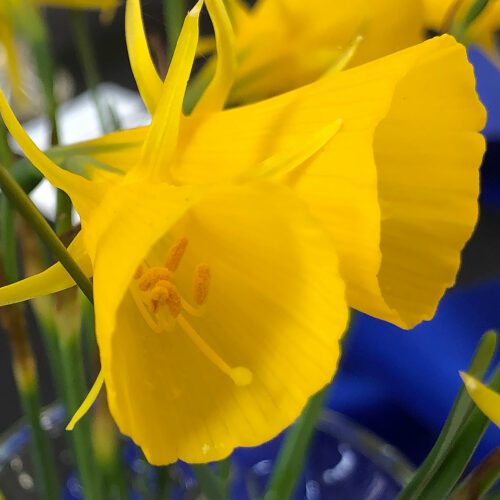
Bulbocodium daffodils, often known as Hoop Petticoat Daffodils, have a very large flared trumpet and tiny petals that almost disappear behind it, giving the flowers a distinctive petticoat shape.
Cyclamineus types are generally better suited to woodland gardens, borders and naturalising, while Bulbocodium varieties excel in alpine gardens, rockeries, raised beds and containers where their unusual flowers can be appreciated at close range.
Propagation
Over time, bulbs will produce offsets and form small clumps.
- Division – Lift and divide in summer once foliage has died back
- Seed – The species can also be grown from seed, though it takes longer
Where To Buy

2 Jacksons Hill Rd, Menzies Creek VIC 3159
Hundreds of different varieties of daffodils as well as other beautiful spring & autumn flowering bulbs for home gardeners. Free colour catalogues available. Tulips, Daffodils,Alliums, Freesias, Iris and many other bulbs.
www.daffodilbulbs.com.au

'Sylvan Vale' 375 Olinda Creek Rd, Kalorama, VIC.3766
Including a large range of Rare and unusual bulbs, corms and perennials
www.tonkinsbulbs.com.au

357 Monbulk Road SILVAN VIC 3795
Guaranteed "garden worthy" bulbs, plants and perennials. Visit the website to browse our large range of daffodils or request the latest free catalogue.
www.tesselaar.net.au
More Daffodils

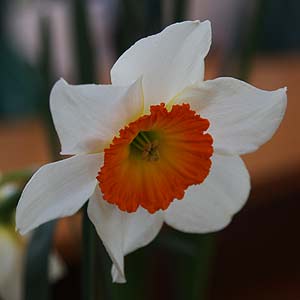

Frequently Asked Questions
Are Cyclamineus daffodils good in pots?
Yes. Their compact growth makes them one of the best daffodils for containers and small garden spaces.
Do they multiply?
Yes. Established bulbs gradually produce offsets that can be divided every few years.
Are they fragrant?
Some cultivars have a light fragrance, although they are generally grown for their distinctive flower form rather than perfume.
Are they poisonous?
Like all daffodils, the bulbs and foliage are toxic if eaten and should be kept away from pets and young children.