
The Giant Himalayan Lily.
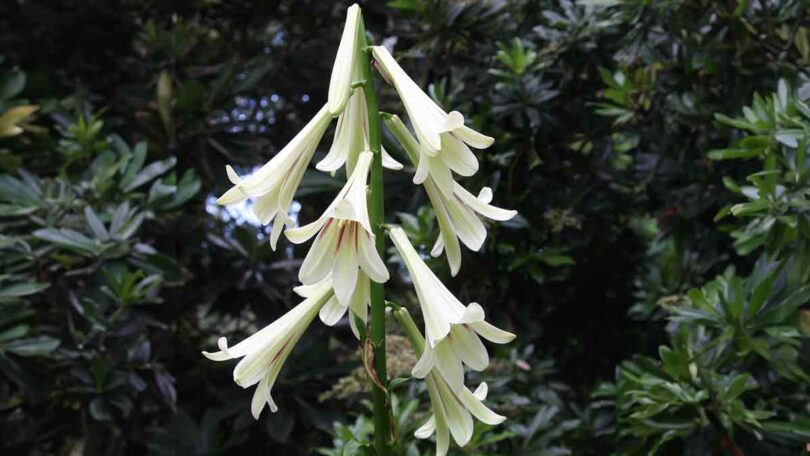
Commonly called the Giant Himalayan Lily, Cardiocrinum giganteum is from the lillaceae family and is the tallest growing of any lily.
Spectacular flowers on a single tall stem, this is also one of the most impressive flowers for any garden. It has been in cultivation for well over 100 years, and is a plant that like a humus rich moist soil. It grows best in dappled shade, it will not survive in full sun, and for use grows well beneath a large Copper Beech tree near the drip-line.
Flowering time will vary depending on the climate, the warmer the climate, the earlier it will flower.
How to grow Cardiocrinum Giganteum – Basic Care
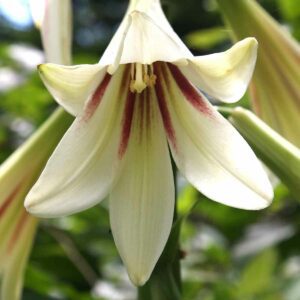
We grew ours from seed given to us by Mrs Tindale, of Tindale gardens in the Dandenong ranges.
Requiring shade and moisture (and patience) Cardiocrinum giganteum take about 9 years from seed to flowering size.
However we do think that a 3m high lily with great drooping flowers on a huge stem, its worth the wait, and will certainly be a talking point. Of course you could just buy an advanced Cardiocrinum giganteum bulb and not wait so long.
- Climate
Best in a frost free position will cool to mild winters and warm summers. Avoid freezes and avoid hot dry climate zones. - Soil
Deep humus rich soil and mist however not wet and soggy, so good drainage. - Position
Best in dappled shade, grow this one in a position beneath taller trees, but with good filtered light.
Protect from strong winds. - Watering
Water deeply if conditions become dry. Ensure adequate water when coming into flower. - Fertiliser
We use some aged cow manure and some blood and bone, around the plant applied each spring along with a deep layer of mulch set back from the stem itself. A general purpose slow release fertiliser in spring could also be applied.
Top Tip
These are also a hungry plant, well rotted compost, leaf mould and a slow release organic fertiliser will assist with growth.
Cardiocrinum giganteum Propagation Techniques.
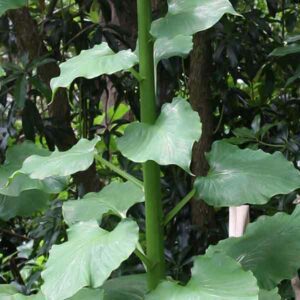
Cardiocrinum giganteum is a monocarpic bulb: the main bulb flowers once, then dies, but usually forms a number of offsets (bulblets) around the base.
Plants strongly resent disturbance, so only lift and divide when necessary, and expect flowering to be delayed after moving.
Two methods of propagation are used:
- Division of Offsets
- Propagation From Seed
Propagation by Division
f you are going to divide the offsets, be aware that they do resent being moved, and this may set back flowering for a few extra years. The best time to divide if you must is after the main bulb has flowered.
Wait until it dies back and them divide the offsets. The plants featured in this article were given to us by Mrs Tindale of Tindale Gardens fame. From small offsets they took 7 years to flower.
- Wait until after the main stem has flowered and died right back, so the clump is dormancy before lifting.
- Lift the whole clump carefully with a fork, keeping as much root and surrounding soil intact as possible.
- Separate the offsets by hand; keep scales and roots attached to each offset. The dead, spent central bulb is discarded.
- Prepare new planting position, a humus‑rich soil , moisture-retentive but well‑drained soil, in partial shade with shelter from hot sun and strong wind
- Replant offsets immediatly, at roughly the same depth they were growing (bulbs often sit shallow, near the soil surface).
- Space bulbs adequately to allow for growth, 45–60 cm.
- Water in well and keep evenly moist – Avoid wet or soggy conditions.
- Be patient Cardiocrinum offsets can take several 4 – 8 years to reach flowering stage
Propagation From Seed
Propagation from seed is slow however you will get many more plants this way. For best germination rates use fresh seed.
After flowering, allow seed pods to ripen and collect it ready to planting.
Sow fresh seed after collecting in late summer–autumn and leave outdoors in a protected, shaded position, allowing winter chilling and spring warming to trigger germination. Protect young seedlings and plants from slugs and snails.
- Seeds need cycles of warm and cold (stratification), so germination is often slow and can takeover 1–2 years.
- Use a deep pot or seed tray to allow for root development
- Use a free‑draining, humus‑rich seed mix (e.g., quality seed compost with added grit or perlite)
- Sow on the surface or very lightly cover with about 1–2 mm of fine compost, horticultual grit or vermiculite; do not bury seed deeply.
- Keep the mix just moist, constant moisture is important, ensure good drainage to prevent rot.
- Seeds may spend the first year developing underground (hypogeal germination) so germination is not always obvios at first. Then the send up grass‑like leaves
- Once the seedlings are large enough to handle prick out seedlings , keeping as much root and surrounding mix as possible.
- At this stage you can decide to grow in individual pots or plant out in small clumps in humus‑rich, moist but well‑drained compost in partial shade
Cardiocrinum varieties are available including :
- C. cordatum
- C. giganteum var. yunnanense.
- C. cathayanum
We Are Asked?
Can you grow Cardiocrinum giganteum in pots?
Yes, however we do not recommend it as the plant takes such a long time to flower and it resents being transplanted.
Is Cardiocrinum giganteum frost tolerant?
Although it will survive most light frosts we recommend planting the giant lily in a frost free position and certainly protect it from frost over winter with mulch or similar.
Should You Deadhead Cariocrinum Giganteum
Yes, unless you wish to collect the seed.
Good companion plants include
Where To Buy

PO Box 7040 Leura NSW 2780
Rare woodland plants, Trilliums Epimediums, Arisaemas, plus much more.www.lynnsrareplants.com.au

Large variety of Epimediums, Woodland plants and Herbaceous perennials
Mail order or nursery. We do not send to Tasmania or WA
www.cloverhillrareplants.com

357 Monbulk Road SILVAN VIC 3795
Guaranteed "garden worthy" bulbs, plants and perennials. Visit the website to browse our large range of daffodils or request the latest free catalogue.
www.tesselaar.net.au