
When we think of Australian native trees a few species immediately spring to mind. Of course the Eucalypts and the Wattles are at the top of the list, while the Queensland Bottle Tree and the recently discovered Wollemi Pine (Wollemia nobilis) are also well known.
However, there are many other types of Australian native trees that are well suited to growing in the Australian garden.
Both feature trees as well as screening and windbreak trees, along with types that act as habitat trees, can all be found among Australian native species.
The choice is enormous, from small flowering trees suitable for the suburban garden through to large-growing trees better suited to parks, acreage and larger landscapes.
Choosing Australian Native Trees for the Garden
One of the advantages of Australian native trees is the range of forms available. Some are grown mainly for flowers, others for foliage or bark, while some are valued for their ability to provide shelter, screening and habitat.
Before choosing a tree, consider the eventual height and spread, the position available and the local climate. A tree that is excellent for a large park may not be the best choice for a small suburban garden.
Australian native trees can be used for:
- Feature and specimen trees
- Screening and privacy
- Windbreaks
- Shade
- Habitat and wildlife gardens
- Flowering displays
- Coastal planting
- Large parks and open landscapes
- Street and roadside planting
- Revegetation and naturalistic gardens
- Choosing Australian Native Trees for the Garden
- Flowering Australian Native Trees
- Australian Native Trees for Large Gardens
- Australian Native Trees for Screening and Windbreaks
- Small to Medium Australian Native Trees
- Australian Native Trees for Habitat and Wildlife
- Australian Native Trees for Shade
- Australian Native Trees for Coastal and Exposed Areas
- Some Less Well-Known Australian Native Trees
- Australian Native Trees – Choosing the Right Tree
- Quick Selection Guide
- Australian Native Trees for Warm Climates
- More Australian Trees
Flowering Australian Native Trees
If it is brilliant flowers you are looking for, there is certainly no shortage of Australian native trees to choose from.
Acacia pycnantha is the Golden Wattle, Australia’s floral emblem, with its familiar bright yellow flowers. It is a smaller tree and can also be used as a feature plant where space is limited.
Brachychiton acerifolius, the Illawarra Flame Tree, is another great native tree for subtropical Australia. When conditions are right it produces a spectacular display of brilliant red flowers, often when the tree is partly or completely bare of leaves.
Corymbia ficifolia, the Red Flowering Gum, is another iconic Australian native tree. Once commonly known as Eucalyptus ficifolia, it now belongs in the genus Corymbia. It is widely grown for its brilliant red, pink or orange flowers and is one of the native trees that can make a real statement in the garden.
Telopea speciosissima, the Waratah, is a small tree to large shrub and one of our best-known flowering natives. The large red flowers are spectacular and make this an excellent choice for a feature position where conditions are suitable.
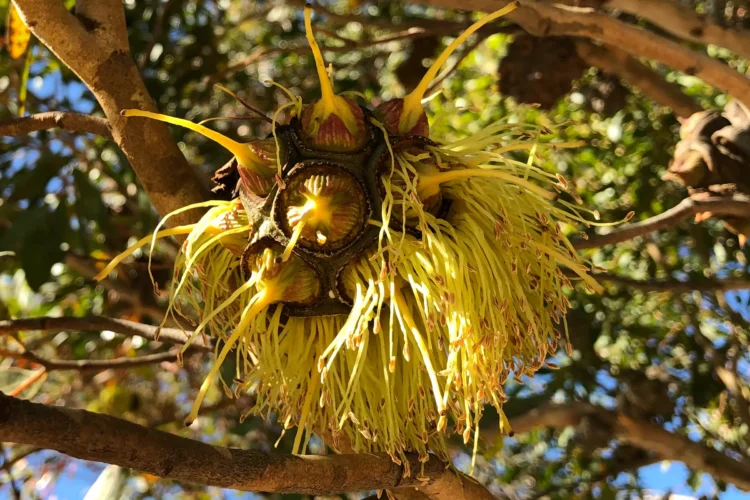
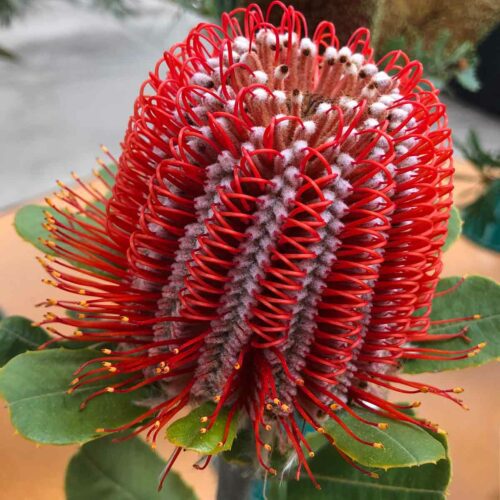
The Banksias are another group worth considering. Species such as Banksia integrifolia, Banksia spinulosa and Banksia marginata range from large shrubs to small trees, with flowers that are also valuable to native birds and insects.
Australian Native Trees for Large Gardens
For larger gardens, parks and open landscapes, some of the Australian native trees that are often overlooked make excellent specimens.
Angophora costata and Angophora floribunda are two examples. These are larger-growing trees with attractive trunks, foliage and flowers and are excellent specimens where there is enough room to allow them to develop properly.
The Bunya Pine, Araucaria bidwillii, is another one for large parks and large properties. It has dark, prickly foliage and a massive trunk and can become an impressive landscape tree. This is certainly not a tree for a small suburban garden.
Toona ciliata, the Australian Red Cedar, is another tree that many Australians may not immediately recognise as a native. It is better known historically as a timber tree rather than a landscape tree, but it is an important Australian native and an impressive large tree where space permits.
Australian Native Trees for Screening and Windbreaks
If you are looking for screening or a windbreak, several groups of Australian native trees are particularly useful.
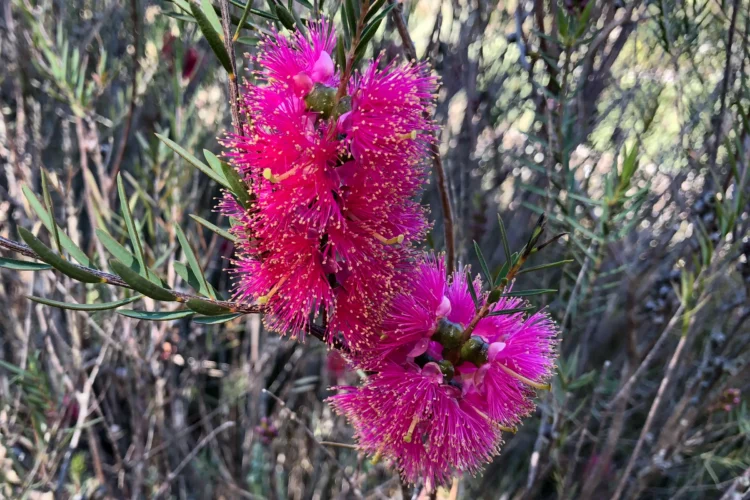
The Leptospermums, or Tea Trees, include excellent smaller trees and shrubs that can be used for screening, hedges and informal planting. They are useful where a dense native planting is required without necessarily choosing a large Eucalypt.
The Paperbarks, or Melaleuca species, are another group worth considering. Some species make good screening trees and many have wonderful texture in the trunks and bark.
The Casuarinas and Allocasuarinas, commonly known as She Oaks, are also useful trees for open planting, windbreaks and more exposed sites. They are particularly effective in naturalistic and roadside plantings.
When choosing a screening tree, look at the mature height and width rather than relying on the size of the plant when purchased. Regular pruning may keep some trees under control, however it is generally better to choose a tree that naturally suits the space.
Small to Medium Australian Native Trees
Not every Australian native tree needs to be a giant.
Backhousia citriodora, the Lemon-scented Myrtle, is an excellent small to medium-sized tree with attractive foliage and a lovely lemon scent when the leaves are crushed. It is a useful tree for the home garden, particularly in warmer areas.
Smaller Banksias, Tea Trees and Wattles also provide plenty of choice for gardeners looking for a tree that will not eventually dominate the garden.
For the suburban garden, this smaller group of Australian native trees is often the better place to start.
Australian Native Trees for Habitat and Wildlife
Australian native trees are also important as habitat trees.
Eucalypts, Banksias, Melaleucas, Bottlebrushes, Wattles and other native species can provide food, shelter and nesting sites for birds, insects and other wildlife.
When choosing a tree for a habitat garden, look beyond the flowers. Fruit, seed, nectar, bark, hollows and the structure of the tree can all have value.
Older trees can be particularly important habitat trees, which is one reason why retaining suitable mature native trees where possible is valuable.
For smaller gardens, planting a number of smaller native trees and shrubs can create a useful layered habitat rather than relying on one large tree.
Australian Native Trees for Shade
Larger trees such as Eucalypts and Angophoras can provide substantial shade, however there are also many smaller native trees and shrubs that can be used where a more modest canopy is required.
The important thing to remember with shade trees is that the eventual canopy is much larger than the trunk area of the tree when it is young.
Allow room for the roots and canopy to develop, particularly when planting near buildings, paving, pools and underground services.
Australian Native Trees for Coastal and Exposed Areas
Some Australian native trees are particularly well suited to exposed conditions, including coastal sites.
Casuarina and Allocasuarina species are well known for their ability to cope with exposed positions and are widely used in coastal and roadside landscapes.
Tea Trees and some Banksias can also be useful, depending on the species and the local conditions.
As always, choose the species for the actual site. Coastal conditions can mean salt spray, strong winds, poor sandy soil and low moisture, so a tree that is suitable for one coastal location may not necessarily perform well in another.
Some Less Well-Known Australian Native Trees
If we said Toona ciliata, most Australians would say, “never heard of it”, yet this is the Australian Red Cedar. It may not be famed as a landscape tree but is well known as a timber tree.
Nothofagus cunninghamii, the Myrtle Beech, is another native tree that is not as well known in general gardening circles. It is an evergreen rainforest tree from Tasmania and southern Victoria and is a major component of cool temperate rainforest.
Nothofagus moorei, the Antarctic Beech, is another large Australian native tree from cool rainforest areas of New South Wales and Queensland. Both are interesting trees for collectors and for larger landscape projects where the conditions are suitable.
These are very different trees from the familiar Eucalypts and Wattles, and they show just how diverse Australian native trees really are.
Australian Native Trees – Choosing the Right Tree
There is no single “best” Australian native tree. The best tree is the one that suits the position, climate, soil and available space.
- For a small garden, look towards smaller Banksias, Tea Trees, Wattles and other compact native trees.
- For screening, consider Leptospermum, Melaleuca, Casuarina and suitable Banksia species.
- For a feature tree, Angophora, Brachychiton, Corymbia and selected Eucalypts provide plenty of choice.
- For habitat, look for trees that provide nectar, seed, fruit, shelter or nesting opportunities.
- And for large properties and parks, some of the magnificent larger-growing Australian trees can be used to create a landscape that will last for generations.
Australian native trees offer an enormous range of shapes, sizes, flowers, foliage and bark. With a little thought about the final size and the conditions in the garden, there is a native tree for almost every Australian landscape.
Quick Selection Guide
| Garden Use | Trees to Consider |
|---|---|
| Small feature tree | Banksia, Backhousia, smaller Acacia |
| Flowering tree | Corymbia, Brachychiton, Angophora |
| Screening | Melaleuca, Leptospermum, Casuarina |
| Windbreak | Casuarina, Allocasuarina, selected Melaleuca |
| Habitat | Eucalypts, Banksia, Melaleuca, Acacia |
| Large garden | Angophora, Bunya Pine, Eucalypts |
| Tropical/subtropical | Firewheel Tree, Umbrella Tree, Illawarra Flame Tree |
| Coastal | Casuarina, Allocasuarina, suitable Banksia |
Australian Native Trees for Warm Climates
There are many excellent native trees for tropical and subtropical Australia.
Heptapleurum actinophyllum, formerly widely known as Schefflera actinophylla and the Umbrella Tree, is a tropical to subtropical tree that can reach around 10–15m. The foliage forms an umbrella-like canopy and the red flower spikes appear above the foliage, generally in the warmer months.
Stenocarpus sinuatus, the Firewheel Tree, is another warm-climate tree. Related to the Proteas, it can reach over 30m in its natural environment, although it is generally much smaller in cultivation. The brilliant red flowers are the main attraction.
The Illawarra Flame Tree, Brachychiton acerifolius, is another excellent choice for subtropical Australia where there is sufficient room.
These trees are best suited to areas where the climate and available space match their requirements.
More Australian Trees