
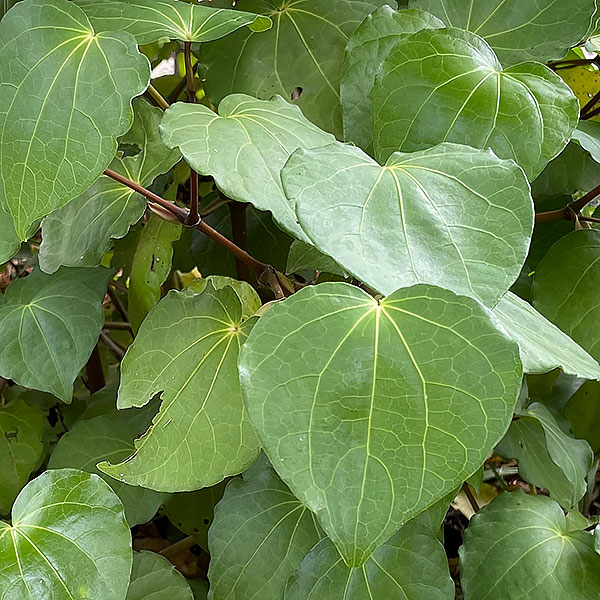
Known simply as Kawakawa, Piper excelsum is a handsome evergreen shrub to small tree native to New Zealand and a member of the pepper family. Formerly known botanically as Macropiper excelsum, it is closely related to the black pepper plant (Piper nigrum).
Grown for its attractive heart-shaped foliage, aromatic leaves and naturally dense habit, Kawakawa is an excellent foliage plant for shaded gardens. While it has long been valued in traditional Māori rongoā (healing practices), we grow Kawakawa primarily as an ornamental plant. The lush green foliage provides year-round interest, and we’ve found it to be a reliable, easy-care shrub that brings a subtropical feel to the garden.
Although naturally an understory plant, we’ve also found it grows well in full sun to part shade, depending on climate. In cooler coastal areas it handles full sun well with adequate moisture, while in warmer inland regions it develops its best foliage in dappled shade or protection from hot afternoon sun.
Quick Facts
- Botanical name: Piper excelsum
- Common name: Kawakawa (pronounced kawa kawa)
- Plant type: Evergreen shrub or small tree
- Height: 2–5 metres
- Spread: 2–3 metres
- Position: Full sun to part shade (depending on climate)
- Best light: Dappled shade in warm climates
- Soil: Moist, humus-rich, well-drained soil
- Water: Regular watering while establishing
- Growth rate: Moderate
- Flowers: Small green flower spikes
- Fruit: Orange berries on female plants
- Frost: Protect young plants from frost. Established plants tolerate light frosts.
- Suitable for pots: Yes, especially while young
Piper excelsum Description
With mid-green, heart-shaped leaves carried on dark stems, Kawakawa forms a dense, fleshy evergreen shrub with attractive foliage throughout the year. The leaves have a distinctive peppery fragrance when crushed, making it an appealing plant to grow close to paths, outdoor living areas or garden entrances.
Naturally found growing beneath taller trees in coastal and lowland forests, Kawakawa is perfectly suited to woodland gardens and shaded borders. Given time it can reach around 5 metres in height, although it responds well to pruning and is easily maintained as a compact shrub around 2 metres tall.
Female plants produce decorative orange berries following flowering. If you wish to produce fruit and seed, both male and female plants are required.
How to Grow Kawakawa
Growing Kawakawa is straightforward once established. Providing suitable moisture and shelter while plants are young will reward you with vigorous, healthy growth.
Position
Kawakawa naturally grows as an understory plant beneath larger trees, making it ideal for dappled shade.
In our experience, it is more adaptable than many gardeners expect. In cooler coastal climates it grows happily in full sun provided the soil remains reasonably moist. In hotter inland climates, part shade or protection from harsh afternoon sun helps maintain lush, healthy foliage.
Choose a warm, sheltered position, particularly while young plants establish.
Soil
Plant in a humus-rich, well-drained soil with plenty of organic matter.
Although Kawakawa appreciates consistent moisture, it dislikes waterlogged conditions. Incorporating compost before planting and applying organic mulch each spring helps retain moisture and improve soil structure.
Watering
Regular watering is important during the first growing season.
Established plants tolerate short dry periods but perform best with consistent moisture, especially during prolonged dry weather.
Fertiliser
Feed in spring using a quality organic slow-release fertiliser or well-rotted compost.
An occasional application of seaweed solution during the growing season helps encourage healthy root development and lush foliage.
Pruning
Remove any dead or damaged growth as required.
Light pruning can be carried out at almost any time of year, although spring is ideal. Regular trimming encourages a dense, bushy habit, making Kawakawa suitable for screening or as a feature foliage shrub.
We’ve found it responds particularly well to occasional tip pruning, producing fresh new growth and maintaining an attractive compact shape.
Propagation
Kawakawa is readily propagated from semi-hardwood cuttings taken during summer and can also be grown from seed.
Remember that male and female flowers occur on separate plants, so both are needed if you wish to harvest fruit or collect seed.
Garden Uses
Although Kawakawa is widely recognised for its traditional medicinal uses, we think its greatest value in today’s gardens is as an outstanding foliage plant.
Its dense evergreen growth makes it ideal for:
- Woodland and understory plantings
- Native New Zealand gardens
- Tropical and subtropical style gardens
- Coastal gardens
- Shaded borders
- Feature foliage planting
- Informal screening
- Courtyard gardens
- Large containers while youngy.
The glossy heart-shaped foliage combines beautifully with ferns, clivias, hostas and other shade-loving plants, adding texture and year-round greenery
Traditional Māori Uses
Kawakawa holds significant cultural importance in New Zealand and has long been valued in traditional Māori rongoā.
Traditionally, the leaves have been used in herbal infusions, while crushed leaves and poultices were applied externally for a variety of purposes. Branches are also traditionally used during tangihanga (funeral ceremonies) and other occasions of cultural significance.
Today, many gardeners grow Kawakawa primarily as an ornamental foliage shrub while also appreciating its long history and cultural importance.
Our Experience Growing Kawakawa
We’ve grown Kawakawa mainly as a foliage plant and have found it to be one of the easiest evergreen shrubs for adding year-round colour and texture to shaded areas of the garden.
While it naturally grows beneath taller trees, we’ve also had good success growing it in full sun in cooler climates, provided plants receive adequate moisture during dry periods. In warmer areas, part shade produces the best foliage.
One of its greatest strengths is its versatility. Left alone it develops into a handsome small tree, while regular pruning keeps it dense and compact, making it equally useful as a background shrub or feature foliage specimen.
Common Problems
Kawakawa is generally a low-maintenance and reliable plant.
Young plants may occasionally attract snails or slugs, while aphids or scale insects can sometimes appear on new growth. Healthy plants growing in suitable conditions rarely suffer from significant pest or disease problems.
Poor drainage is the most common cause of decline, so always plant in well-drained soil.
Where to Buy Kawakawa
Kawakawa is available from many specialist online plant nurseries ( Check For Availability) and some garden centres.
If you hope to produce berries or collect seed, remember to purchase both male and female plants.

138 Olinda-Monbulk Rd, Olinda VIC 3788
"Large range of rare and unusual plants.."
www.gentiananursery.au