
Duranta – A Popular Flowering Hedge Plant

Duranta is a fast-growing evergreen shrub that has long been popular as a hedging and screening plant in warm climate gardens. It is valued for its colourful flowers, dense foliage and ability to respond well to pruning, making it a favourite with landscapers and home gardeners alike.
The best known cultivar is Duranta ‘Geisha Girl’, prized for its masses of mauve-blue flowers edged in white that appear through spring and often continue into summer. Other popular cultivars include ‘Sheena’s Gold’, grown for its bright golden foliage, ‘Alba’ with white flowers and ‘Blue Cascade’.
While Duranta is an attractive and hardy garden plant, it does have some drawbacks. In parts of Australia it has become an environmental weed, with birds spreading the seed from its berries. Before planting, it is worth checking whether it is suitable for your area.
About Duranta
Duranta, often listed as Duranta erecta (formerly D. repens), is native from Mexico through Central America and into South America. It grows naturally in tropical and subtropical climates but adapts well to many temperate areas of Australia.
In frost-free climates it remains evergreen throughout the year. In cooler districts it may lose some or all of its leaves during winter before producing fresh growth in spring.
Depending on the cultivar and growing conditions, Duranta can reach anywhere from 2 to 6 metres in height if left unpruned, although it is easily maintained as a compact shrub or hedge with regular trimming.
Popular Duranta Varieties
Several cultivars are commonly available.
Duranta ‘Geisha Girl’
The most popular flowering form, producing deep green foliage and attractive mauve to purple flowers with crisp white edges. Flowering is usually heaviest in spring, with repeat flowering often occurring during the warmer months.
Duranta ‘Sheena’s Gold’
Grown mainly for its brilliant golden foliage, this variety is widely used for formal hedging, borders and low screens.
Other Cultivars
Other forms occasionally available include:
- D. ‘Alba’
- D. ‘Blue Cascade’
- D. ‘Aussie 2000’
- D. ‘Lorentzii’
Each has slightly different foliage colour, growth habit or flower colour but all have similar growing requirements.
Used widely as hedging plant or low growing windbreak Duranta repens is popular with landscapers for its easy to prune nature. The best known varieties include the popular ‘Geisha Girl’, wonderful blue flowers in spring and good green foliage year round.
This is a group of small compact shrubs to trees for tropical to semi tropical areas. Originally from Southern Florida D. erecta is commonly known as golden dewdrop, pigeon berry and sky flower. Duranta sheena’s gold and Duranta ‘geisha girl’ are popular cultivars.
D. repens and D. Erecta along with D. ‘Alba’ are the best known species. Duranta are a versatile plant that will grow from the tropics through to temperate regions. D. stenostach and is another species to look at, although not widely grown.
Other Cultivars include: D. Aussie 2000, D. Giesha Girl, D. Lorentzii and D. Blue Cascade
How to Grow Duranta
Duranta grows best in tropical and subtropical climates but performs well as far south as Sydney and parts of the NSW South Coast in protected positions.
Position
Choose a position in full sun for the best flowering and dense growth. Plants will tolerate light shade but usually produce fewer flowers.
Soil
Grow in a well-drained soil enriched with compost or organic matter before planting.
Watering
Although established plants are reasonably drought tolerant, regular watering during prolonged dry periods encourages healthier growth and more flowers.
Fertiliser
Apply a slow-release fertiliser once each year in spring or use well-rotted cow manure together with blood and bone. Finish with a layer of mulch to conserve soil moisture and improve soil structure.
Pruning
Duranta responds extremely well to pruning and can be maintained as:
- Formal hedges
- Informal screens
- Feature shrubs
- Small standard trees
- Topiary
For the best display of flowers, prune immediately after the main flowering period.
If growing ‘Geisha Girl’ as a standard, begin training while the plant is young by selecting a single central leader and removing lower side shoots until the desired height is reached. Staking may be required while the trunk develops.
Regular pruning encourages a dense, bushy habit and helps keep hedges neat and compact.
Growing Geisha Girl in Pots
Although usually planted in the ground, Geisha Girl also grows well in large containers.
Use a quality premium potting mix, keep the soil evenly moist and feed annually with a controlled-release fertiliser. Container-grown plants are easier to keep compact and make it simpler to remove spent flowers before berries develop.
Landscaping Uses
Duranta is commonly used as:
- Formal and informal hedges
- Privacy screens
- Windbreaks
- Feature shrubs
- Topiary
- Large container specimens
Its colourful flowers also attract bees and butterflies, adding extra interest to the garden.
Potential Problems
Like many vigorous garden plants, this one has a few drawbacks that should be considered before planting.
Weed Potential
The bright orange berries are attractive to birds, which readily spread the seed into nearby bushland and gardens.
In Queensland and some other parts of Australia, Duranta is regarded as an environmental weed in many areas. If you choose to grow it, remove spent flower heads before berries develop to help prevent self-seeding.
Growing plants in containers is another way to reduce the risk of unwanted seedlings.
Grow me Instead
If weed potential is a concern, consider alternatives such as Syzygium australe, Westringia, Callistemon or other Australian native hedging plants.


Poisonous Berries
The berries are poisonous if eaten and may cause nausea, vomiting and stomach pain. Keep this in mind if young children or pets regularly use the garden.
Thorns
Older plants often develop sharp thorns along the stems, making them less suitable beside paths, driveways or children’s play areas.
Leaf Colour Changes
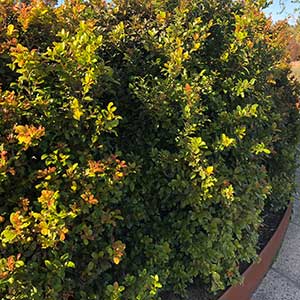
Yellowing or discoloured foliage is usually caused by cold weather, frost damage or occasionally a manganese deficiency.
Propagation
Easily propagated from hardwood cuttings taken during the warmer months. Cuttings strike readily under suitable conditions and quickly develop into vigorous young plants.
Frequently Asked Questions
Is Duranta the same as Geisha Girl?
No. Geisha Girl is one of the best-known cultivated varieties of Duranta erecta.
Is Duranta invasive?
Some forms are considered invasive in parts of Australia because birds spread the seed from the berries. Check local recommendations before planting.
Is Duranta poisonous?
Yes. The berries are poisonous if eaten by people or animals and should not be consumed.
Can Duranta be grown in pots?
Yes. Geisha Girl is well suited to growing in large containers where it can be easily pruned and managed.
When should Duranta be pruned?
The best time to prune is immediately after the main flush of flowers. Regular trimming encourages a dense habit and repeat flowering.