
The evergreen dogwood tree is Cornus capitata, also known as the Himalayan strawberry dogwood. This is a small tree that can reach a height of around 9m in good conditions, although it is often less. Green foliage is maintained throughout the year, however, some leaf fall in winter can occur in cooler climates.
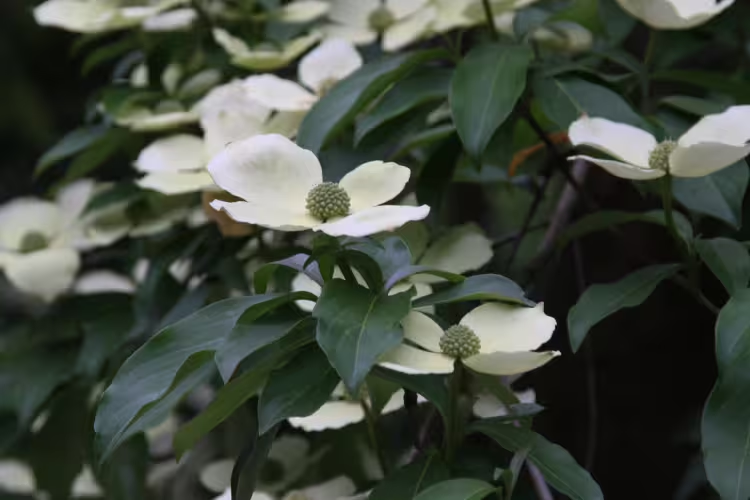
Quick Facts – Cornus capitata
- Common name: Evergreen Dogwood, Himalayan Strawberry Dogwood
- Botanical name: Cornus capitata
- Mature height: Around 9m, often less
- Growth rate: Fairly fast when young, slowing with age
- Foliage: Evergreen, with some winter leaf fall in cooler climates
- Flowers: Large yellow flowers from late spring to summer
- Fruit: Green fruits that turn yellow and then red as they ripen
- Best use: Feature tree or planting at the rear of a garden border
- Pruning: Generally little required
- Potential problems: Fruit drop and self-seeding
The evergreen dogwood has large yellow flowers that appear from late spring to summer and are attractive in the garden. These are followed by green fruits that turn yellow and then red as they ripen.
Although it is a useful landscaping tree, it does have its problems. Firstly, it will self-seed, and as birds are attracted to the fruit, it can spread into native forest areas and become a little ‘weedy’. In the garden, these seedlings are easily pulled out when young.
However, the main issue in the garden is the fruit, which can be fairly messy. If planted near a pathway, it will require a ‘daily clean’ when in full fruit. Unfortunately, with larger established specimens, this can continue for a few months.
How to grow Cornus capitata – Basic Care
Evergreen dogwoods are not particularly fussy about soil conditions, although they will thrive in humus-rich, moist conditions.
Cornus capitata is fairly fast-growing at the beginning, but the growth rate slows as the tree matures. It can take around 20–30 years to reach a fully mature specimen.
Although little pruning is required, the tree can become a little leggy in shaded positions and may require some attention to maintain a better shape.
Landscaping Uses
I
In larger gardens, the Evergreen Dogwood (Cornus capitata) can be used as a feature tree or planted at the rear of a garden border to provide some shade.
We suggest that you do not plant an Evergreen Dogwood tree near paths or driveways due to the fruit drop, which can become messy when the tree is in full fruit.
Is Cornus capitata a Good Garden Tree?
Cornus capitata can make an attractive feature tree, particularly for its evergreen foliage, yellow flowers and colourful fruit. It is relatively easy to grow and does not require extensive pruning.
However, its tendency to self-seed and the amount of fruit that can drop from established trees should be considered when choosing a planting position. For this reason, it is better suited to larger gardens and areas away from paths, driveways and other areas where fallen fruit could become a problem.
Other Dogwood Trees
- General Cornus species and cultivars
- Cornus Norman Haddon
- Cornus alternifolia
- Cornus kousa