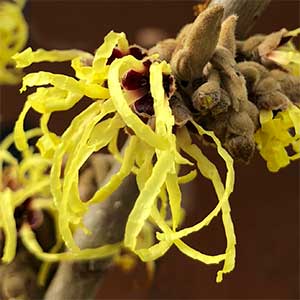

Corylopsis spicata, commonly known as Spike Winterhazel, is a winter-flowering deciduous shrub or small tree from Japan.
It is grown primarily for its masses of pale golden-yellow flowers that appear from late winter into early spring, bringing colour to the garden at a time when little else is in bloom.

Related to the Witchhazels, it shares a similar seasonal appeal, with flowers borne on bare stems before the foliage emerges.
Key Features
- Botanical Name: Corylopsis spicata
- Common Name: Spike Winterhazel
- Height: Up to 3 metres
- Spread: Around 2 metres over time
- Growth Rate: Medium to fast
- Flowers: Pale golden yellow, fragrant
- Flowering Period: Late winter to spring
Foliage and Flowers
The foliage emerges with an attractive bronze tint before maturing to a mid-green. Leaves are oval, with a deeply veined and textured appearance that provides interest well beyond the flowering season.
Flowers are borne in graceful, hanging racemes around 5 cm in length. They appear on bare branches, are lightly fragrant, and persist well, making them suitable for cutting and indoor display.
Growing Conditions for Corylopsis spicata
Position
Plant in full sun to light shade. In warmer climates, a position with dappled afternoon shade will help protect the foliage and maintain plant health.
Soil
Prefers a humus-rich, well-drained soil with consistent moisture. Avoid dry or compacted soils.
Watering
Water well after planting and maintain even moisture, particularly during establishment. Mulching helps retain soil moisture and keep the root zone cool.
Care and Maintenance
Corylopsis spicata is naturally multi-stemmed with a soft, shrub-like habit and requires minimal maintenance when grown in suitable conditions.
Pruning
Pruning is rarely necessary. However, branches can be selectively removed after flowering for use in cut flower arrangements. Avoid tip pruning, as this can disrupt the plant’s natural form.
Mulching
Apply mulch annually to conserve moisture and improve soil structure.
Landscaping Uses
- Ideal for mixed garden borders
- Effective as a seasonal feature plant
- Suitable for woodland-style or informal gardens
- Adds colour and interest in winter and early spring
- Works well as a background foliage plant through warmer months
With its fragrant flowers, it is also a good choice for sensory gardens, where scent and seasonal variation are important.
Varieties
- ‘Ogon’ (syn. ‘Aurea’) – Noted for its golden foliage
- ‘Golden Spring’ – Features bright golden leaves in spring
These cultivars are valued for their foliage colour as well as seasonal flowering.
Propagation
Propagation is relatively straightforward using cuttings taken after flowering. With the right conditions, plants establish well and develop into multi-stemmed specimens over time.
Summary Information
- Height: To 3 metres
- Spread: To 2 metres
- Soil: Humus-rich, well-drained, moisture retentive
- Position: Full sun to part shade
- Flowering: Late winter to spring
- Pruning: Minimal required
- Growth Rate: Medium to fast
You May Also Like