
A group of rosette forming succulents from Mexico and nearby areas, with over 40 species, Dudleya offer variety for the collector and gardener alike.

These are spring flowering plants, growing actively during the winter months, grown mainly for the foliage which varies in colour and shape.
Flower colour varies from yellow through to red depending on the species. With the common name of ‘Live Forever’ they really are a tough little succulent in the right climate.
Some are branched and some are unbranched
These are a low growing group of plants, most species reaching less than .4 metre in height. They are evergreen, grow well in containers, and make great specimen plants in a contemporary landscape setting or mediterranean style garden.
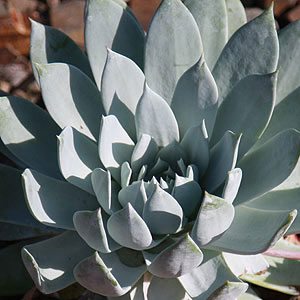
How to Grow Dudleya – Basic Care
Use a specialist succulent and cacti potting mix, if you are growing them in the ground, ensure good drainage.
They grow best in a position where they are protected from the heat of the afternoon sun, and all species require protection from frosts.
To avoid fungal problems and making the foliage it is better to water Dudleya from below the foliage.
Summer Care – Dormancy
Dudleya are usually dormant in summer through to autumn/fall. So summer care is something like this.
- Reduce watering – Water barely once a month or rely on natural rainfall; overwatering causes root rot
- Provide shade – Keep in bright shade or protect from intense afternoon sun to prevent burning and preserve leaf health
- Don’t clean excessive dry leaves – Allow brown, shriveled lower leaves to remain; they protect the plant from heat and desiccation
- Resume watering in late autumn/fall – When night temps drop to 13–16°C (50–60°F)
- Dudleya wakes up; gradually return to regular watering
Problems
- Powdery Mildew – Caused by damp conditions and poor air circulation.
- Snails and Slugs – Especially on new growth.
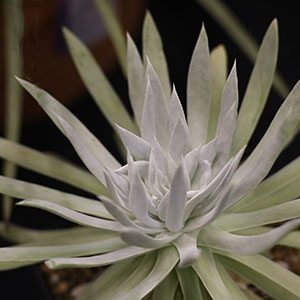
Varieties
- D. farinosa – This is a species with a very attractive powdery coating on the leaves. Sometimes called the powdery live for ever.
- D. brittonii – With upright sticks of bluish foliage this plant is know as the Giant Chalk Dudleya.
- D. albiflora is a neat rosette forming species.
- D.pulverulenta is commonly called the ‘Chalk Dudleya’
Propagation
The easiest method of propagation is by removing offsets. Leaf cuttings are also reliable. Propagation from seed is also possible.
Over time, Dudley may form a stem which may become unsightly in some eyes. This can easily be remedied by removing the rosette with some stem and re rooting the cutting.
Where To Buy
Look For Dudleya at specialist Succulent and Cactus sales.