
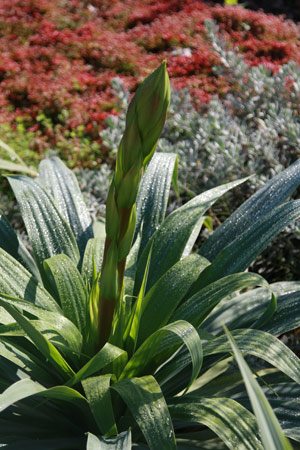
Beschorneria yuccoides, commonly known as the Mexican Lily, is a striking evergreen succulent perennial native to Mexico.
Valued for its bold architectural foliage and spectacular flower spikes, it is one of the most widely grown species in the genus.
Although it has a distinctly tropical appearance, Beschorneria is surprisingly hardy and adapts well to a range of Australian climates.
With its attractive rosettes of blue-green foliage and dramatic spring flowers, Beschorneria yuccoides makes an excellent feature plant for modern gardens, Mediterranean-style landscapes and large containers.
Description
The long, sword-shaped leaves form dense rosettes that create year-round interest in the garden. The foliage is generally blue-green to grey-green and arches gracefully outward, giving the plant a sculptural appearance.
After several years of growth, mature plants produce tall flower spikes that rise well above the foliage. The stems are often pink to reddish in colour and carry masses of pendulous pink-red flowers. These spectacular blooms appear from spring into early summer and attract nectar-feeding birds and beneficial pollinators.
Growing to around 1 metre high and wide in foliage, with flower spikes reaching up to 2 metres, Beschorneria yuccoides can become a real focal point in the landscape.
Quick Guide
| Feature | Details |
|---|---|
| Botanical Name | Beschorneria yuccoides |
| Common Name | Mexican Lily |
| Plant Type | Evergreen succulent perennial |
| Height | 1m foliage, 2m flowering spikes |
| Position | Full sun to part shade |
| Soil | Well-drained, fertile soil |
| Water Needs | Low once established |
| Frost Tolerance | Moderate |
| Drought Tolerance | High |
| Container Growing | Excellent |
| Propagation | Division of offsets |
Landscaping Uses
The bold foliage and drought tolerance of Beschorneria make it a versatile garden plant. It works particularly well in:
- Mediterranean-style gardens
- Dry climate and water-wise landscapes
- Coastal gardens
- Succulent and cactus collections
- Contemporary architectural plantings
- Gravel gardens
- Large decorative containers
- Courtyard gardens
Its dramatic foliage provides year-round structure, while the tall flower spikes add seasonal interest and height.
Growing Conditions
Beschorneria yuccoides performs best in:
- Full sun to part shade
- Well-drained soil
- Moderately fertile conditions
- Areas protected from severe frost
While it tolerates a wide range of soil types, plants perform best in humus-rich soils with good drainage. Once established, they show good drought tolerance and require little supplemental watering except during prolonged dry periods.
Care and Maintenance
Beschorneria is generally a low-maintenance plant.
Apply a slow-release fertiliser in spring to encourage healthy growth and flowering. Water regularly during establishment, then reduce watering as plants mature.
Remove spent flower spikes and damaged foliage as required to maintain a tidy appearance.
Although reasonably frost tolerant, severe frosts may damage the foliage. Damaged leaves can be trimmed away once new growth begins.
Propagation
Propagation is usually by division.
As mature plants develop offsets around the base, these can be carefully removed and replanted during spring or early autumn. Ensure each offset has a healthy root system before transplanting.
Propagation from seed is possible but is generally slower and less commonly used by home gardeners.
Pests and Problems
Beschorneria is generally trouble-free.
Occasional issues include:
| Problem | Cause | Solution |
|---|---|---|
| Root rot | Poor drainage or overwatering | Improve drainage and reduce watering |
| Snail and slug damage | Young foliage being eaten | Use suitable controls if required |
| Frost burn | Severe winter frosts | Remove damaged foliage in spring |
| Poor flowering | Insufficient sunlight | Move to a sunnier position |
Where To Buy
52 Rodd St Canowindra NSW 2804
An online nursery specialising in drought and frost tolerant perennials and fragrant, edible and herbs.
www.perennialle.com.au
Our Thoughts
Beschorneria yuccoides is a hardy and rewarding ornamental plant that combines drought tolerance with dramatic architectural appeal. The attractive evergreen foliage provides year-round interest, while the tall flower spikes create a spectacular display in spring and early summer.
Easy to grow, adaptable to a range of conditions and suitable for both garden beds and containers, the Mexican Lily remains an excellent choice for gardeners seeking a low-maintenance feature plant with strong visual impact.
Species and Varieties
Several species and cultivars are available, each with slightly different characteristics.
| Species or Cultivar | Foliage | Flowers | Notes |
|---|---|---|---|
| Beschorneria yuccoides | Blue-green | Pink-red | Most commonly grown species |
| Beschorneria albiflora | Green | White | Unusual white-flowering species |
| Beschorneria rigida | Stiffer blue foliage | Red-pink | More upright habit |
| Beschorneria tubiflora | Broad foliage | Red | Larger flowering stems |
| Beschorneria wrightii | Grey-green | Red | Good drought tolerance |
| Beschorneria yuccoides ‘Flamingo Glow’ | Variegated green and cream | Pink-red | Excellent feature plant |
| Beschorneria yuccoides ‘Reality’ | Variegated foliage | Pink-red | Decorative foliage year-round |