
A striking evergreen barrenwort with spiny foliage and creamy spring flowers – ideal for shady woodland gardens.
We have been growing Epimedium wushanense ‘Sandy Claws’ for around 10 years, it is a reliable performer in the garden, easy care andd the new foliage and flowers are eyecatching. One of the very best epimediums for year round interest.
Quick overview
- Type: Evergreen perennial
- Common Name: Sandy Claws Barrenwort, Fairy Wings
- Botanical Name: Epimedium wushanense ‘Sandy Claws’
- Height/Spread: 12–18″ tall × 18–24″ wide
- Climate Zones: Cool temperate to Mediterranean type climates. USDA Zones: 5 to 8 (possibly Zone 4 in protected sites)
- Light: Part shade to full shade
- Soil: Well-drained, humus-rich, prefers slightly acidic soils
- Water: Moderate: drought-tolerant once established
- Flowering: Mid to late spring, cream-white flowers
- Foliage: Spiny, lance-shaped, emerging bronzed, maturing green
- Deer/Rabbit Resistant: Yes
- Garden Uses: Groundcover, woodland garden, underplanting trees/shrubs
Plant Description
Foliage & Texture
‘Sandy Claws’ is named for its distinctive, sharply serrated, lance-shaped leaves that resemble spiny holly. New foliage emerges in spring with a rich bronze to copper tint before transitioning to a glossy deep green by summer. The plant remains evergreen in milder climates, adding texture year-round.
Flowers
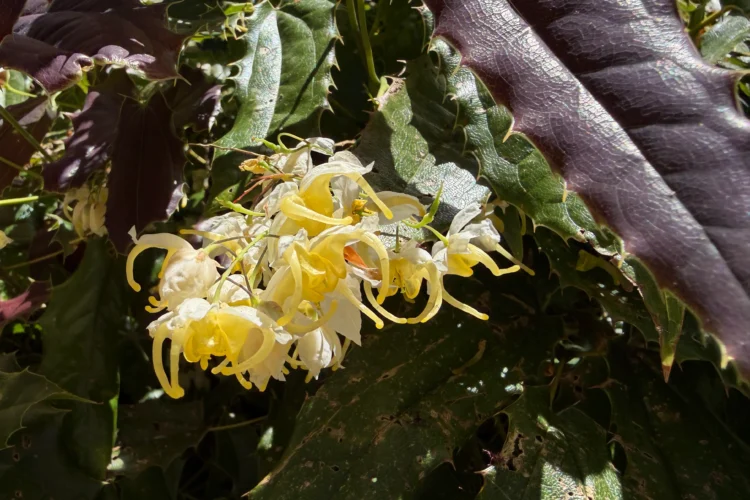
In mid to late spring, upright wiry stems emerge with clusters of delicate, creamy-white flowers tinged with soft yellow. The flowers resemble tiny orchids or fairies in flight — hence the common name “Fairy Wings.”
Growth Habit
This clumping perennial grows in a slowly spreading mound, making it ideal as a groundcover or accent plant in shaded beds. It spreads by short rhizomes and naturalizes over time without being invasive.

Close-up of flowers of Epimedium Sandy Claws

Cultivar Origin & History
‘Sandy Claws’ is a named clone of Epimedium wushanense, a species native to the Wushan Mountains in China, particularly the areas of Chongqing, Guizhou, Hubei, and Sichuan. It was introduced to the U.S. by epimedium expert Darrell Probst in 2006
Growing & Care Guide
Light Requirements
Thrives in part to full shade. Tolerates deep shade under trees but performs best with dappled morning light.
Soil Preferences
Prefers rich, loamy, well-drained soil. It tolerates dry conditions once established but appreciates mulch and occasional water in summer.
Watering
Keep moist in its first growing season to establish roots. Once established, it is drought-tolerant and suitable for dry-shade planting.
Fertiliser
This is not a plant that requires a lot of fertiliser when grown in good soil. We use a slow release pelletised fertiliser every second year along with the occasional liquid fertiliser.
Maintenance Tips and Pruning
- Cut back old foliage in late winter to showcase new spring leaves and flowers.
Make sure you prune back beffore new growth commences so as not to damage new flower spikes and leaf growth. Removing old foliage also provides a fresh new look in spring. - Mulch annually with compost or leaf mold.
- Division is rarely necessary but can be done in early spring or autumn fall.
Where & How to Use in the Garden
‘Sandy Claws’ belongs in shaded and woodland plantings where its fine foliage adds structure among broader-leafed plants. It’s perfect beneath trees, in the company of ferns or hellebores, or even in Japanese-inspired settings where leaf form and texture are key. Once established, it handles dry shade and requires very little care.
Ideal Garden Settings
- Woodland gardens
- Dry shade borders
- Underplanting trees/shrubs
- Japanese-style or zen gardens
- Rock gardens (in shaded zones)
Why Is Epimedium wushanense ‘Sandy Claws’ Such a Good Plant?
- It’s Evergreen.
- Amongst epimediums it has unique texture
- It is fairly Deer & rabbit resistant
- It tolerates dry shade – so low water needs.
- It is an unusual and Rare cultivar which adds garden interest year round.
Potential Problems
Epimedium wushanense ‘Sandy Claws’ is generally pest- and disease-free. The only problem we have is with Slugs or snails damaging the new foliage, rarely causing major damage. Tolerates urban pollution and performs well in sheltered courtyard gardens.
More Epimediums


Companion Plants
Look for other shade plants that are not prone to spread quickly, especially avoid plants such as Solomon’s Seal (Polygonatum spp.) that can end up crowding out others and can be difficult to remove.
We suggest:
- Ferns
- Hellebores (Helleborus spp.)
- Hostas
- Pulmonaria
- Brunnera