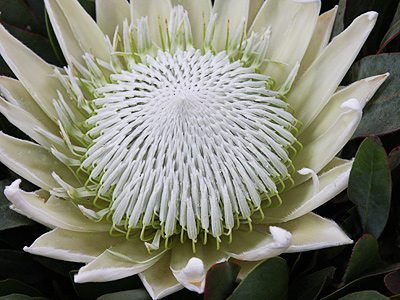

Big flowers on small Protea plants.
If you are looking for a bird-attracting plant with large flowers for a smaller garden, then a dwarf Protea could be the answer.
For many years Proteas were regarded as large shrubs that were best suited to larger gardens. Today, a number of compact and smaller growing cultivars are available, bringing these striking plants within reach of smaller gardens, courtyards and containers.
Most dwarf Proteas grow to around 1 metre (3ft) in height with a similar spread, although some remain closer to 50cm. Flowering is generally from late autumn through winter and into spring, depending on the variety. They are also well suited to coastal gardens and are an excellent choice for water-wise landscapes.
Popular Dwarf Protea Varieties
- White Crown
White Crown is one of the smallest dwarf Proteas, growing to around 50cm in height. It produces pure white flowers above light to mid-green foliage and is particularly well suited to containers or smaller gardens. - Pink Crown
Pink Crown has a similar compact habit, although it is usually a little taller than White Crown. It produces attractive pink flowers over a long flowering season. - Little Prince
Little Prince is a larger growing dwarf variety, reaching around 1 metre in height. The dark pink flowers, with their contrasting white central cone, make it an excellent feature plant.
How To Grow Dwarf Proteas
Dwarf Proteas are easy to grow provided they receive plenty of sunshine and excellent drainage. Like all Proteas, they dislike wet feet and will perform best in well-drained soils.
Soil
A slightly acidic, free-draining soil is essential. If your garden has heavy clay or is prone to waterlogging, improve drainage by planting on a raised mound.
For containers, use a quality free-draining potting mix suitable for Australian native plants.
Sunlight
Plant in a position that receives full sun for the best flowering. Light shade is tolerated, however flowering is reduced in heavily shaded positions.
Watering
Once established, dwarf Proteas are drought tolerant and require little supplementary watering except during extended dry periods.
Container-grown plants will need more frequent watering, allowing the potting mix to dry slightly between watering.
Fertilising
Like all Proteas, dwarf varieties are sensitive to phosphorus.
Avoid high-phosphorus fertilisers, including chicken manure, blood and bone, along with many general-purpose garden fertilisers.
Choose a fertiliser formulated for Australian native plants with little or no phosphorus. An NPK ratio with zero or very low phosphorus, such as 10-0-8 or 6-1-1, is suitable.
Pruning
Pruning is generally limited to removing spent flower heads. This is also the best time to lightly shape the plant if it becomes untidy.
Garden Landscaping Uses
The compact habit of dwarf Proteas makes them useful in a wide range of garden situations.
They are well suited to:
- Smaller gardens
- Courtyard gardens
- Containers and patio pots
- Native gardens
- Coastal gardens
- Water-wise landscapes
- Mixed shrub borders
- Feature planting near entrances or entertaining areas
Their long-lasting flowers are excellent for cutting and provide welcome colour through the cooler months, while also attracting honeyeaters and other nectar-feeding birds.