
Egyptian Blue Water Lily

The Blue Lotus, Nymphaea caerulea, is one of the most sought after water garden plants. Commonly known as the Egyptian Blue Water Lily, it is prized for its striking blue flowers and historical significance.
Despite the name, this plant is not a true lotus. It is a tropical water lily, best suited to ponds and still water conditions.
The flowers are large, typically 10 – 15 cm across, held above the water on upright stems with contrasting yellow stamens. Flower colour can vary from soft blue through to mauve depending on growing conditions and form.
Key Features
- Botanical name: Nymphaea caerulea
- Common names: Blue Lotus, Egyptian Blue Water Lily
- Flower size: 10 – 15 cm
- Position: Full sun
- Water type: Still or slow moving
- Plant type: Tropical water lily
How to Grow the Blue Lotus Water Lily
- This is a plant that likes water that is fairly still, they do not grow well in moving water. They are best kept away from fountains and do not grow well in most water features.
- You will need a sunny position, 6 – 8 hours of sun each day is ideal.
- They grow best in a container submerged in the pond on a shelf.
- The best time to plant the tubers is in spring as the temperature warms up.
- All lotus need to be planted so that the foliage is on the surface.
- Fertiliser can be applied directly to the growing container in summer.
As with all water lilies, foliage should sit on or just below the water surface once established.
Flowering occurs from spring through to late summer, with plants becoming dormant over winter.
Origins and Background
Native to Egypt and parts of East Africa, the Blue Lotus grows naturally along the edges of slow moving rivers, including the Nile.
It has long been associated with ancient Egyptian culture, where it symbolised rebirth and the origins of life. The plant features rounded green leaves and star-shaped flowers that open during the day to reveal a bright yellow centre.

Blue Lotus vs True Lotus
The name “Blue Lotus” can be misleading.
- True lotus belong to the genus Nelumbo and produce large emergent leaves and flowers held well above the water.
- Blue lotus is a water lily (Nymphaea), with floating leaves and flowers held just above the surface.
This distinction is important when selecting plants for ponds and water gardens.
Related Species and Naming Confusion
The name “Blue Lotus” is often used for a number of different plants.
- Nymphaea nouchali (also referred to as Nymphaea stellata in older texts) is called Blue Water Lily or Star Lotus. This is a subtropical species that grows well in Australia, including Melbourne.
- Nymphaea caerulea is more strictly tropical and less tolerant of cold conditions.
All of these are water lilies, not true lotus.
Traditional Uses
Nymphaea caerulea has a long history of traditional use in ancient Egypt, where it was associated with relaxation, ritual, and symbolism. These uses are historical and should not be taken as modern medical advice.
Climate Suitability
This is a tropical water lily and performs best in warm climates.
Australia
Best suited to northern and warmer regions. In cooler areas such as Melbourne and southern Victoria, plants may struggle through winter unless grown in a protected position or treated as seasonal.
North America
Suitable for USDA Zones 10 – 12 as a perennial.
- In Zones 8 – 9 it can be grown as a summer plant, but will need overwintering indoors or in heated water.
- In Zones 7 and below it is generally treated as an annual or grown in controlled conditions.
Europe
Best suited to Mediterranean and mild regions (equivalent to USDA Zones 9 – 11).
- In cooler parts of the UK and northern Europe, it can be grown in summer but will not survive winter outdoors.
- Overwintering requires a greenhouse or heated indoor space.
You may also be interested in
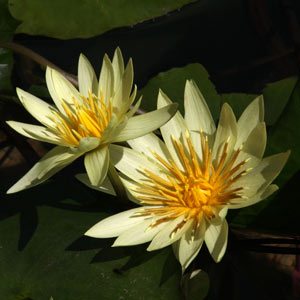
Flower colors will vary from pink to mauve and truer blues depending on the variety.
We Are Asked
Is Blue Lotus a real lotus?
No. Blue Lotus (Nymphaea caerulea) is a water lily, not a true lotus. True lotus belong to the genus Nelumbo.
What depth should Blue Lotus be planted at?
Typically 20 – 40 cm of water above the container is ideal, depending on plant size and stage of growth.
Does Blue Lotus need full sun?
es. At least 6 – 8 hours of direct sunlight is needed for good flowering.
Can Blue Lotus grow in moving water?
No. It prefers still or very slow moving water and does not perform well in fountains or fast-flowing features.
Is Blue Lotus the same as Nymphaea nouchali?
No. While both are sometimes called Blue Lotus, Nymphaea nouchali is a different species and is more tolerant of cooler climates.