
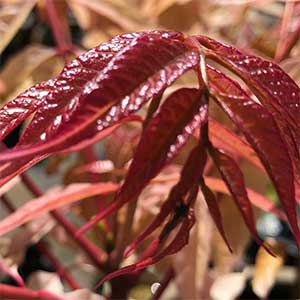
If you have ever been walking in spring and wondered what those tall trees with the absolutely brilliant bright pink foliage are, they could well be the Toone Tree or Chinese Cedar.
Cedrela sinensis, commonly known as the Chinese Cedar or Toon Tree, is a graceful deciduous tree celebrated for its brilliant pink new growth in spring. As the foliage matures to soft green and later glows golden in autumn, this tree offers three seasons of colour and interest. Growing to around 7–9 metres, it’s ideal as a feature tree or ornamental shade tree in cooler and temperate gardens.
Native to East Asia, this hardy tree thrives in well-drained, humus-rich soil and enjoys a cool winter for best spring colour. With its moderate growth rate, easy care, and elegant form, Cedrela sinensis adds both beauty and structure to the landscape — from home gardens to avenue plantings.
How to Grow Cedrela sinensis – Basic Care
A well drained soil is essential and these trees are best in areas where they do not receive heavy frosts in spring.
Position and Light
Plant in full sun for the best spring colour and healthy growth. The Toon Tree tolerates partial shade but the pink flush will be less intense. Choose a position protected from strong, drying winds.
Soil
A well-drained, humus-rich soil is ideal. The tree prefers slightly moist, fertile soil, but it’s adaptable once established. Avoid waterlogged positions.
Soil pH: Neutral to slightly acidic (around 6.0–7.0).
Planting
When planting Cedrela sinensis :
- Dig the hole twice the width as the pot the tree came in and just a little deeper.
- Add some aged compost and cow manure to the soil removed from the hole.
- Position the tree at the same depth as it was in the container. Adjusting the depth of the hole as needed
- Place the plant in the hole.
- Backfill with the improved soil mix.
- Water in well with a liquid seaweed fertiliser.
- Apply a thick mulch layer around the base to retain moisture.
Watering and Feeding
- Keep soil consistently moist during the first few summers while the roots establish.
- Once mature, trees are moderately drought tolerant, but benefit from deep watering in dry periods.
- Feed annually in spring with a slow-release organic fertiliser or well-rotted compost.
- Supplement with a seaweed or fish-emulsion tonic during the growing season for improved foliage colour and health.
Temperature and Climate
Cedrela sinensis prefers cool to temperate climates and appreciates a cold winter for dormancy.
It performs particularly well in areas like Melbourne, Tasmania, and the Southern Highlands, where it experiences distinct seasonal changes.
Although hardy, young foliage can be damaged by late frosts, so choose a sheltered planting position in frost-prone areas.
Frost tolerance: Moderate (avoid heavy spring frosts).
Drought tolerance: Medium once established.
Pruning
Prune during winter dormancy to maintain shape or control height. Cedrela responds well to pruning — even hard pruning can rejuvenate older trees. Remove suckers if they appear at the base to maintain a single trunk and tidy form.
Propagation
Propagation is usually by seed, although softwood cuttings can be taken in spring with moderate success.
Seeds germinate readily when fresh and can be started in a warm, protected position.
Landscaping Uses
The Chinese Cedar is perfect as a feature tree for spring colour or as an ornamental deciduous shade tree in small to medium gardens. It also performs well in avenue plantings, parks, and commercial landscapes thanks to its upright form and low maintenance needs.
The vibrant pink foliage provides an eye-catching contrast against evergreen backdrops and darker foliage plants. In China, young shoots are also used as a culinary vegetable, valued for their distinctive flavour and aroma.
Species and varieties
Not all foliage is pink when new, some Cedrela sinensis cultivars have a much deeper red foliage. The new young shoots are sometimes used as a vegetable in China, and the seeds as ‘sprouts’.
Cedrela sinensis are a tree that will sucker, so do not be afraid to remove any that you do not want. You can also prune them back in winter if you wish.
Did You Know?
- The new shoots of Toona sinensis are eaten as a spring vegetable in Asia — often stir-fried or added to omelettes.
- In China it’s called ‘Xiang Chun Shu’, meaning ‘fragrant spring tree’.
- The wood is light, aromatic, and sometimes used for furniture and musical instruments.
Summary Information
- Botanical Name – Cedrela sinensis syn. Toona sinensis.
- Common Names – Chinese Cedar, Toon Tree, Chinese Flamingo Tree.
- Country of origin – Nepal through to China
- Position – Full Sun
- Soil – Fertile, well-drained, humus-rich.
- Height – To around 7 – 9 metres.
- Spread – To around 3 metres.
- Growth Rate – Moderate to Fast.
- Foliage – Bright pink new growth turning green in summer, yellow in autumn
- Evergreen / Deciduous – Deciduous
- Frost tolerant – Yes, but avoid heavy spring frost
- Drought tolerant – Medium.
- Uses – Feature tree, ornamental, avenue, edible shoots
Toone trees are available for sale form the following nurseries

412 James Lane, Fern Hill VIC. 3458 - Phone 0419002651
Large range of Rare plants, Climbers, Bulbs, Perennials Fruit Trees, Ornamental Trees and Shrubs. Available both Retail and by Mail Order
www.whitehousenursery.com.au

125 Palmer Rd Jindivick 3818
Open Thursday - Sunday 10am - 4pm
Specialising in growing and selling Rare and Unusual Trees, shrubs Perennials Bulbs and Climbers, a unique nursery with amazing stock.
www.muskersbroughtonhall.com.au
You May Also Like


