

If you’re after a drought-tolerant, dependable flowering plant, Penstemon should be on your list. These perennials are celebrated for their long, late flowering period — making them a valuable addition to garden borders and cottage-style gardens.
Penstemon varieties brought from North America and Asia — and extensively hybridised — offer diversity in both foliage and flowers. Some, like the red-foliaged ‘Husker’s Red’, deliver interest all year round.
Depending on the variety, Penstemon plants may grow over 1 meter tall (e.g. ‘Mother of Pearl’) or stay compact around 60 cm (e.g. ‘Peace’), giving flexibility for different garden spaces.
From classic cottage gardens to modern native-inspired landscapes, Penstemon earns its place thanks to:
- Long flowering: Late spring through autumn
- Low water needs once established
- Pollinator appeal (bees and birds love them)
- Easy care, making them ideal for all skill levels
How To Grow Penstemon- Basic Care
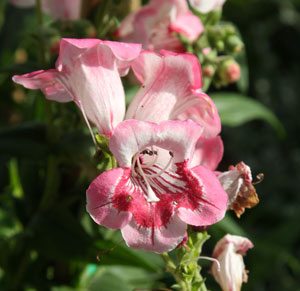
How to Grow and Care for Penstemon
Light & Soil: Plant in rich, humus-filled, well-draining soil and give them plenty of sunlight. While they’ll survive in part shade, full sun ensures the best flowering.
Watering & Maintenance:
- Water regularly until plants are established; afterwards they become very drought-tolerant.
- Provide extra water and occasional fertiliser during dry, hot periods.
- In winter, ensure soil drains well — Penstemon dislike being waterlogged when dormant.
- Pruning & Division:
- After the first wave of flowers, a light prune helps keep the plant tidy.
- Every 3–4 years divide crowded clumps in late winter to maintain vigour.
Landscaping Uses
Penstemons shine in cottage gardens, perennial borders, mixed beds, and even containers. Their colourful tubular flowers — ranging from red and purple through to pink and white — add vertical interest and attract pollinators.
Compact varieties are especially useful for front-of-border planting or small garden beds, while taller ones work well at the back of mixed beds or as part of wildlife-friendly plantings.
Low growing Alpine varieties are well suited to growing in rock gardens.
Propagation
Penstemon plants can be propagated by division, or from seed.
Propagation By Division
By Division: Best done in late winter. Carefully dig up the clump, divide into healthy sections — ensuring each division retains a good root portion — and replant in rich, well-prepared soil.
Propagation From Seed
From seed you can either sow directly to the garden or start the seeds of in a propagation try.
- Seeds are best sown after the danger of frosts has past.
- Sow the seeds in trays using a fine seed raising mix.
- Cover lightly and keep moist.
- Using a heated propagation tray will speed up germination.
- Usually the seeds will germinate within 14 days.
- A low rosette will form first and then a flower stalk much later.
- The seedling should be grown on for 4 – 6 weeks after germination before planting out.
Penstemon at a Glance
- Botanical name: Penstemon
- Common name: Beard Tongue
- Type: Perennial
- Height: 50 cm – 1.2 m (variety dependent)
- Flowering: Spring to late autumn
- Climate: Thrives in temperate, Mediterranean, and warm climates
Popular Penstemon Varieties
- ‘Firebird’ – Red flowers to 80 cm in height.
- Penstemon ‘Swan Lake’ one of the best white flowering varieties
- ‘Hidicote Pink’ – Mid pink flowers
- ‘Port Wine’ – Purple to Burgundy Flowers
- ‘Russian River’ – Very attractive purple flowers.
- ‘Snow White” – A good white flowering variety.
- Black Bird with deep purple to maroon flowers.
- Sour Grapes.
Pruning Penstemon
After the first flush of flowers you can prune lightly. In spring remove the older woody stems as soon as you see new grow beginning from the base of the plant.
With minimal maintenance and impressive, long-lasting blooms, Penstemon is a versatile perennial that suits a wide range of garden styles — from structured cottage beds to relaxed, wildlife-friendly plantings. Its variety of sizes, colours and foliage types offers flexibility while its drought tolerance and low upkeep make it ideal for gardeners of all levels.
Common Problems & Solutions
Floppy Stems
Cause: Too much shade or excess nitrogen.
Fix: Move to full sun; reduce fertiliser; prune lightly.
Root Rot
Cause: Poor winter drainage.
Fix: Improve soil with grit or raise the planting area.
Sparse Flowering
Cause: Overcrowded clumps or old woody growth.
Fix: Divide clumps; prune in late winter.
Where To Buy

Little Hampton, Vic 345
"Mail order nursery specialising in cottage garden perennials, flowering shrubs, Trilliums, Hostas and Pacific Coast Iris. Flat rate express postage - Except WA & TAS"
www.botanicaltreasures.com

52 Rodd St Canowindra NSW 2804
An online nursery specialising in drought and frost tolerant perennials and fragrant, edible and herbs.
www.perennialle.com.au

www.planterspatch.com.au

PO Box 7040 Leura NSW 2780
Rare woodland plants, Trilliums Epimediums, Arisaemas, plus much more.www.lynnsrareplants.com.au

'Umbango' 750 Humula Rd, Humula NSW 2652
Phone 0408692773 Great Range of Perennial plants available for sale by mail order.
www.nutshellnursery.com.au

357 Monbulk Road SILVAN VIC 3795
Guaranteed "garden worthy" bulbs, plants and perennials. Visit the website to browse our large range of daffodils or request the latest free catalogue.
www.tesselaar.net.au