
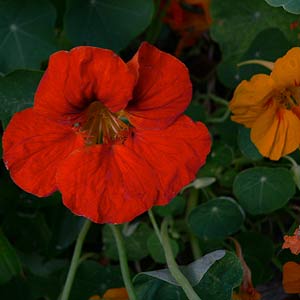
Easy care nasturtiums are one of the easiest flowering plants to grow. They can be grown from seed or seedlings and produce colourful flowers in shades of yellow, orange, red and bi-coloured forms. Fast growing and rewarding, they are ideal for introducing children to the joys of gardening.
Nasturtiums are the common name for several species of Tropaeolum, with Tropaeolum majus being the most widely grown in home gardens. They are popular for their bright flowers, rounded leaves and their ability to quickly cover bare ground, climb over supports or trail from hanging baskets and containers.
The flowers, leaves and even the seeds are edible, adding a fresh peppery flavour to salads and other dishes.
Growing Nasturtiums
Nasturtiums are very easy to grow from seed in a sunny, well-drained position. Sow seeds from spring through to autumn in warm climates, or after the last frost in cooler areas.
A humus-rich, well-drained soil is suitable, although nasturtiums often flower more freely in poorer soils. Avoid heavy applications of fertiliser as this encourages leafy growth at the expense of flowers.
Water regularly while young plants become established, then only during extended dry periods.
Garden and Landscaping Uses
Nasturtiums perform well as:
- ground cover
- trailing plants over retaining walls
- hanging baskets
- containers
- climbing plants when given a trellis or frame.
Once established they often self-seed, providing new plants the following season.
Nasturtium Flowers
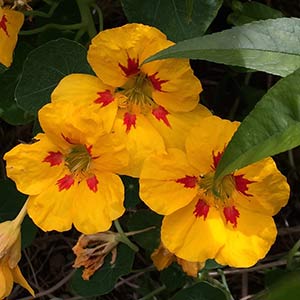
Nasturtium flowers range from soft cream and yellow through to bright orange, scarlet and deep red, with many attractive bi-coloured varieties available.
Regularly removing spent flowers encourages more blooms over a longer period.
Popular varieties include both compact bush forms for pots and vigorous trailing and climbing selections for larger spaces.
Are Nasturtiums Edible?
Yes. Nasturtiums according to most references are entirely edible, with the flowers, leaves and immature seed pods all commonly used in the kitchen.
The flowers and leaves have a pleasant peppery flavour that makes an excellent addition to salads, while the young green seed pods are sometimes pickled and used as a substitute for capers.
Only harvest plants that have not been treated with pesticides or other garden chemicals.
Are Nasturtiums Perennials?
Most garden nasturtiums (Tropaeolum majus and Tropaeolum minus) are grown as annuals. However, because they readily self-seed, they often return year after year in the same garden.
Some lesser-known species, including Tropaeolum speciosum and Tropaeolum polyphyllum, are true perennial nasturtiums in suitable climates.
Do Nasturtiums Come Back Every Year?
In many gardens they do. Although most commonly grown as annuals, nasturtiums readily self-seed, so new plants often appear each spring without any extra work.
In frost-free regions some plants may continue growing for more than one season.
Types of Nasturtiums
Nasturtiums are available in several different growth forms to suit almost any garden.
Mounding Nasturtiums
Compact and bushy, these grow around 25–40 cm tall and are perfect for containers, borders and window boxes.
Popular varieties include ‘Peach Melba’, ‘Whirlybird’ and ‘Alaska Mix’.
Trailing Nasturtiums
Trailing varieties produce stems up to 2 metres long and are ideal for hanging baskets, retaining walls and as a colourful living mulch beneath vegetables.
Popular varieties include ‘Variegatus’ and ‘Purple Emperor’.
Climbing Nasturtiums
Climbing nasturtiums can grow over 3 metres when supported by a trellis, fence or arch.
Tropaeolum tricolor is the best known. A favourite is the beautiful Canary Creeper (Tropaeolum peregrinum), with its distinctive fringed yellow flowers.
Companion Planting with Nasturtiums.
Some insects just love nasturtiums, they like them more than other plants, and this is why they make such a useful companion plant. Aphids love them, so planted near roses they will attract the aphids away from the roses. Grown next to the vegetable garden they serve a similar purpose.
Nasturtiums and Calendula
Calendula and nasturtiums are two of the easiest and most useful companion plants you can grow.
Both produce colourful edible flowers and attract beneficial insects including bees, hoverflies and ladybirds.
There are a few differences between them.
Nasturtiums prefer poorer, well-drained soils and usually flower best without added fertiliser.
Calendula grows best in richer soil and benefits from regular deadheading to keep producing flowers.
While nasturtium flowers have a peppery flavour, calendula petals are milder and are widely used in herbal remedies as well as salads.
Both plants make excellent additions to vegetable gardens.