White English Lavender
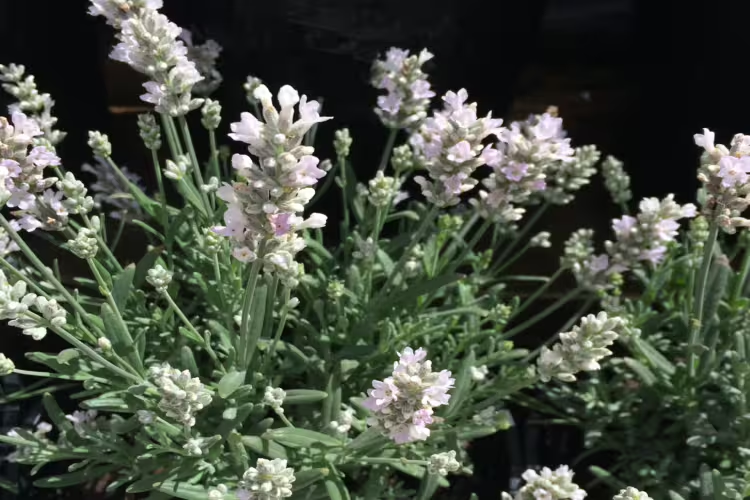
White Lavender seems a little unusual, however a number of white-flowering lavender varieties are available and they do provide a different contrast to the garden. A little rider or disclaimer here: most white lavenders do have just a touch of pale lavender-pink in the flowers as they age. New flowers are generally very white.
Flowering in mid summer, this is a white variety as the name suggests. With snowy white flowers, this variety of English Lavender is fragrant, and the silvery-grey foliage contrasts well against the white flowers which rise above on terminal stems to around 80cm in height.
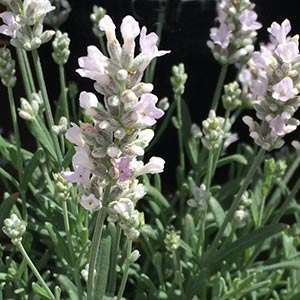
A number of named white lavender varieties are available, including a few lower-growing or ‘dwarf’ forms. You will see it offered simply as English White Lavender, as well as under a number of other names.
Like most species of Lavandula angustifolia, ‘Alba’ grows best in a well-drained, humus-rich soil in a sunny position. Good drainage is particularly important, as lavender does not perform well when the roots remain wet for extended periods.
White lavender is essentially grown in the same way as the better-known purple and blue forms, but the white flowers can be particularly useful where you want a lighter planting scheme or a strong contrast with darker foliage.
- Dwarf White Lavender – Lavandula angustifolia ‘Nana Alba’
- Other White Lavender Varieties
- How To Grow Lavandula angustifolia ‘Alba’ – Basic Care
- When Does White Lavender Flower?
- Landscaping Uses
- Suggested Companion Plants
- White Lavender in Containers
- Is White Lavender Different to Purple Lavender?
- More Lavender Varieties
Dwarf White Lavender – Lavandula angustifolia ‘Nana Alba’
The lower-growing variety Lavandula angustifolia ‘Nana Alba’ will reach around 40cm in height, depending on growing conditions. It is an excellent choice for planting next to paths, as an informal border or low hedge.
‘Nana Alba’ is a compact white English lavender with white flowers held above aromatic foliage, making it particularly useful where space is limited. It is also well suited to containers and small garden beds.
White lavender also looks great when grown in containers. Terracotta pots, stone troughs and other containers with good drainage are particularly suitable.
Other White Lavender Varieties
A number of white-flowering lavenders are available, including both English lavender and lavandin types.
- Lavandula angustifolia ‘Alba’ – White English Lavender
- Lavandula angustifolia ‘Nana Alba’ – Dwarf White English Lavender
- Lavandula × intermedia ‘Alba’ – White Grosso / White Lavandin
- Lavandula stoechas ‘Snowball’ – White-flowering Spanish Lavender
The names used for white lavender can vary between nurseries, so it is worth checking the botanical name when choosing a plant. Lavandula × intermedia ‘Alba’, for example, is a larger lavandin rather than the compact English lavender ‘Nana Alba’.
How To Grow Lavandula angustifolia ‘Alba’ – Basic Care
The same growing conditions apply as for most other lavenders, though the white flowers of ‘Alba’ can make it particularly striking in the garden.
Sunny position.
Choose the sunniest spot available. Full sun encourages strong growth and the best flowering display.
Humus-rich, well-drained soil.
Improve drainage if necessary by raising the bed or incorporating grit. Lavender dislikes sitting in wet soil, particularly in winter.
Mulch around plants in spring to maintain a cool root run.
Use a light, open mulch such as gravel or small stones. Avoid heavy organic mulches directly against the stems.
Fertilise with a slow-release, all-purpose fertiliser in spring.
Lavender does not need heavy feeding, but a light annual application supports steady growth and flower production.
Prune lightly after flowering to encourage a second flush of blooms.
A gentle trim keeps the plant tidy and often rewards you with more flowers later in the season.
Prune back in spring as soon as new growth commences to maintain shape and size.
Aim to remove the previous season’s spent growth while keeping plenty of healthy foliage.
Try not to cut back into old woody stems, as lavenders often struggle to reshoot from bare wood.
When Does White Lavender Flower?
White lavender generally flowers through summer, with the exact flowering period depending on the variety, climate and growing conditions.
In warmer climates, flowering can begin earlier or later depending on the local climate. Regularly removing spent flower stems can help maintain a tidy appearance and may encourage further flowering.
The white flowers are particularly effective against the plant’s grey-green or silvery foliage, and they work well with other plants in a white, silver or Mediterranean-style planting scheme.
Landscaping Uses
This is a versatile plant and be used as single feature or mass planted, try these suggestions.
- Borders and Edging: Ideal for lining paths, driveways, or garden beds, where the white blooms add light and contrast.
- Cottage and Mediterranean-style gardens: Works beautifully in relaxed, sun-drenched plantings.
- White or Moonlight gardens: The clean white flowers glow at dusk and pair well with silver and pale foliage.
- Rock gardens and gravel gardens: The plant’s preference for dry, well-drained conditions makes it a natural fit.
- Containers: Excellent in terracotta pots or stone troughs, particularly near entrances where the fragrance can be enjoyed.
- Herb or sensory gardens: Aromatic foliage and soft flowers contribute scent and texture.
Suggested Companion Plants
Choose plants that enjoy similar sunny, free-draining conditions:
- Silvery, drought-tolerant companions:
Santolina, Artemisia, Perovskia, Helichrysum, Stachys byzantina - Flowering companions for colour contrast:
Salvia, Nepeta, Gaura, Verbena bonariensis, Eryngium - Low mounding forms for edging:
Thyme, Dwarf Rosemary, Teucrium chamaedrys - Grasses for movement and texture:
Festuca glauca, Pennisetum ‘Hameln’, Stipa tenuissima
White Lavender in Containers
White lavender is well suited to container growing, particularly the smaller varieties such as Lavandula angustifolia ‘Nana Alba’.
Choose a container with good drainage and use a free-draining potting mix. Avoid leaving the pot sitting in a saucer of water, as consistently wet roots can lead to problems.
A white lavender in a terracotta pot makes an attractive feature near an entrance, along a sunny patio or beside a pathway where the fragrance can be enjoyed.
Is White Lavender Different to Purple Lavender?
White lavender is not a completely different type of plant. It is simply a group of lavender varieties and cultivars that produce white or near-white flowers.
The growing requirements are much the same as for other lavenders: plenty of sun, good drainage and careful pruning. The main difference is the effect the flowers have in the garden. White lavender provides a softer, brighter contrast to the usual purple, blue and pink flowers.
For a compact white lavender, ‘Nana Alba’ is worth considering, while larger forms such as Lavandula × intermedia‘Alba’ can be used where taller flower stems and a larger plant are required.
More Lavender Varieties