
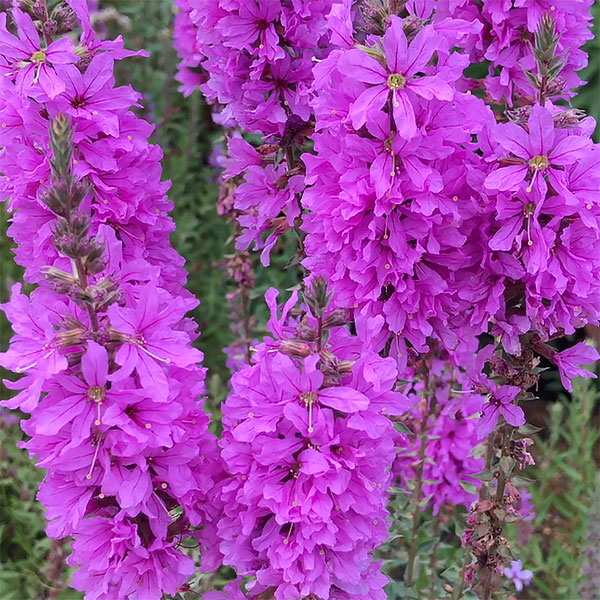
This is a very attractive free flowering species and Lythrum salicaria grows well in the margins of ponds and wetland areas.
The purple flowers appear on upright stems from the end of winter right through summer.
Besides the flowers it does attract bees and Butterflies to the garden.
Overview and Key Features
This upright, clump-forming perennial grows from rhizomes and typically reaches 0.5–1 metre in height. All parts of the plant are softly hairy, with narrow, lance-shaped leaves arranged in opposite pairs or whorls along the stems.
From late winter through summer, tall spikes carry dense clusters of magenta to purple flowers, creating strong vertical interest. These blooms are highly attractive to pollinators, particularly bees and butterflies.
Like many herbaceous perennials, it dies back completely in winter before reshooting in the following growing season.
How to grow Lythrum salicaria
Grown in shallow water this is a very easy care plant.
Prune it back to the base after flowering finished in late summer to winter.
You can grow Purple Loosestrife in drier conditions however flowering is usually do as good.
Purple Loosestrife performs best in consistently moist to wet soils and is ideal for:
- Pond margins
- Bog gardens
- Low-lying or poorly drained areas
It prefers full sun but will tolerate light shade. While it can survive in drier soils, flowering performance is usually reduced.
Maintenance
This is generally a low-maintenance plant when grown in suitable conditions.
- Water: Keep soil consistently moist
- Pruning: Cut back to ground level after flowering (late summer to winter)
- Feeding: Minimal feeding required in rich soils
Spread and Invasiveness
One important consideration is its tendency to self-seed freely. In some regions, particularly North America, Lythrum salicaria is classified as an invasive species due to its ability to outcompete native wetland plants.
For this reason, it is best avoided near:
- Natural waterways
- Agricultural land
- Bushland or conservation areas
Gardeners should monitor spread and remove unwanted seedlings early.
Alternative Plants (Less Invasive Options)
If you’re looking for a similar look without the invasive risk, consider:
- Lythrum virgatum (less aggressive cultivars available)
- Salvia uliginosa (Bog Sage) – tall blue flowers, pollinator-friendly
- Lobelia cardinalis – vivid red spikes for wet soils
- Persicaria amplexicaulis – long-flowering, clump-forming perennial
- Verbena bonariensis – airy purple flowers, better behaved in most gardens
- Native Australian options such as Thalia dealbata (for wet areas) or Dianella species for similar vertical form (though drier tolerant)
Summary Information
- Botanical Name – Lythrum salicaria
- Common Name – Purple Loosestrife
- Family – Lythraceae
- Position – Full sun to dappled shade.
- Soil – Damp and humus rich, best in pond margins.
- Height – Flower stems to around 1 m
- Spread – Will form a clump over time top around 1m or more.
- Foliage – Mid green on tall stems.
- Flowers – Purple to magenta.
- Drought tolerant – No
- Frost tolerant – No
